

How to Write About Love
A conversation with Alexandra Hidalgo about art and earnestly loving things


While I’m away in the woods finishing my novel this week, I hope you’ll enjoy this lovely conversation I had with Substacker, academic, and friend Alexandra Hidalgo, whose great Substack I made my debut in a couple weeks ago!
Also, my July classes are capped at 8 per class and filling up fast! Get a jump on drafting your novel and essays, or download a free Writing Past Fear prompt :)
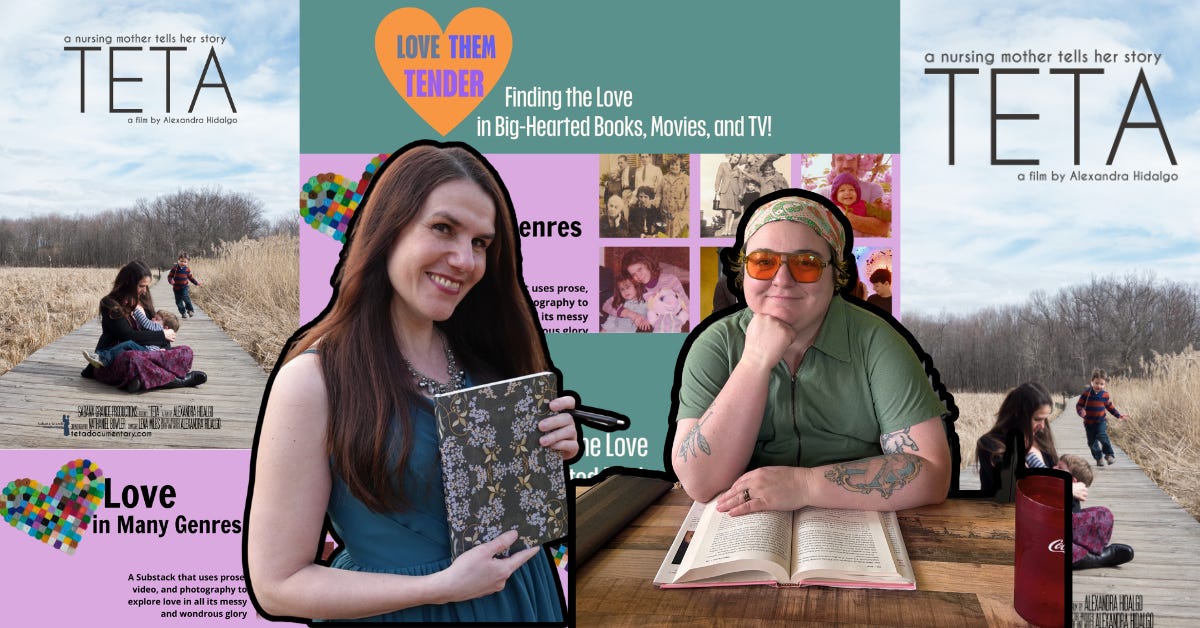
Alexandra Hidalgo is a multi-hyphenate if I ever met one. She left Venezuela for the US at 16, an experience that’s threaded throughout her work, from her documentary filmmaking to her writing and teaching. She’s an endowed associate professor and Crow Chair of English at the University of Pittsburgh, and her writing and documentaries have been featured in The Hollywood Reporter, IndieWire, NPR, The Criterion Collection, and Women and Hollywood.
I met Alexandra on an email listserv, which is, when you think about it, a weirdly old school way to meet a new friend in 2026! We hit it off immediately. I appreciate the way she writes about human relationships and the immigrant experience, and I especially love her openness to earnestly loving things.
In a literary and academic climate where it’s billed as both rational and fashionable to dwell on the Bad Stuff — politics, AI, the dearth of arts funding, etc. etc. — Alexandra’s work is a breath of fresh air. Over at her Substack, Love in Many Genres, she writes with real candor and panache about the many forms of love in her life. And on her YouTube channel Love Them Tender, she offers reviews and analyses of media she loves. Her work is proof that intelligence doesn’t have to be synonymous with constant dissatisfaction; in fact, one can have taste and express it with enthusiasm, even joy! (I know I do.)
Here’s Alexandra on looking back at an early romance:

And here’s our full video interview, with a few more gems on writing and love below:
Raf: What advice would you give to writers who want to write about the painful or vulnerable aspects of love?
Alexandra: When it comes to fiction, I say: go with your heart. Tell the story in a way that moves you. But this is a more layered and complicated matter when it comes to nonfiction and memoir. I often have this conversation with my undergraduate and graduate students. When we write nonfiction and scholarship about our own heartbreak and its many iterations, I tell them to remember that we don’t owe readers anything when it comes to the stories we tell. By which I mean, we come first. We get to reveal what we choose of our wounds, and it’s okay to flat-out say that there are some parts we’re not going to share. In fiction, we often want to tell the whole story, to reveal the pieces slowly or in the most impactful fashion. But in nonfiction we’re telling stories about our own and others’ lives. That means we need to protect ourselves and others, or at least we have the right to do so.
R: You see your purpose as an artist to bring love into the world, which I think is fantastic. How have you seen love — the concept, the feeling — translate itself across your creative mediums?
A: I spent years behind the camera as a documentary filmmaker, and when you’re filming humans interacting with each other, gestures are just there for you to capture. People’s facial expressions, the ways they move, the fluctuations in their voices. It’s all built into the scene you’re filming. It’s one of the gifts of working with moving images, and I spent so many years telling stories through footage that I forgot how to flex that muscle. Fiction, on the other hand, lets you have direct access to your characters interiority in ways that documentary filmmaking doesn’t. You can go into your characters’ heads and hang out there. You can jump from memories to eureka moments to doubts, all while exploring the themes of the story. This is a harder move to pull off in film. Narration can be a tricky tool on screen, while it’s a natural vehicle for fiction. Working in different genres is exhausting (so much to learn for each of them), but it keeps you nimble as a storyteller.
10 Prompts for Writing About Love
Keep reading with a 7-day free trial
Subscribe to The Cosmic Cheeto to keep reading this post and get 7 days of free access to the full post archives.
 | A guest post by
|