


I Tried Being a White Man for Three Years. It Didn’t Go As Planned.
Imagine it’s 2009, and you’re a freshman at a well-regarded liberal arts college who’s been admitted under a DEI policy intended to expand the presence of your identity group on campus. You’re scrolling Tumblr in your dorm room. You’re a little stoned, or you’re taking a three-hour “homework break,” or you’re contending with another bout of teenaged insomnia. You see someone’s reblogged an essay with the above headline. You see the accompanying photo. You think wait – what?! You click. I certainly would have.
If you were young person who dreamed of becoming a professional writer and was addicted to reading the internet between 2008 and 2016, then you saw confessional personal essays proliferating on sites like Thought Catalog, Jezebel, xoJane, the Awl, Buzzfeed, and the Hairpin. The headlines were grippingly lurid, Plath meets pulp: “I’m Not Going to Pretend That I’m Poor to Be Accepted By You” or “There Are No Black People in My Yoga Classes and I’m Suddenly Uncomfortable with It” or, most harrowingly, “On Falling In and Out of Love with My Dad.”
Click and you’d be treated to 1,500-word chunks of selfhood which writers – almost always women – used to advance the terms of “a politics” or “an identity,” as in this particularly uncomfortable example, or (much more optimistically) the notion of the writer herself as a known literary quantity.
There would be no grappling with ideas on the page here, no loose sallies of the mind. Instead, these essays were streamlined to reproduce a well-worn series of emotional beats. Shock, insurmountable obstacle, revelation. Oppression, raised consciousness, resistance. They were exceedingly shareable. They sparked outrage, and clapbacks. Accordingly, they often went viral. Their omnipresence and gray ethics caused Slate editor Laura Bennett to bemoan the “first-person industrial complex” in 2015. Two years later Jia Tolentino, herself a veteran of the form, pronounced the “personal essay boom over.”
“The Internet made the personal essay worse, as it does for most things,” Tolentino wrote, “but I am moved by the negotiation of vulnerability.” She admits to a nostalgia for encountering unusual new voices, watching novice essayists figure out “if they had something to say.” It was certainly a time when the unproven writer could at least take a stab at announcing herself, could even get so lucky as to be heard, agreed with and afforded a kind of thought leadership, however briefly.1
Is the confessional personal essay a form for beginners that arrived with new media verticals and then vanished, as Tolentino claims, in the age of Trump? I doubt it, as Tolentino herself still writes them, however loath she may be to admit it. It’s a form of internet writing that fits hand-in-glove with her collapse-forecasting criticism, as well as the prevailing cultural discourse of the 2010s: identity as ethos, trauma as etiology, modernity and the white men who made it as victimizers of an inexorably damaged lumpen-marginalized.
Take this essay, published in the New Yorker after Donald Trump’s second inauguration. In it, she confesses that her grip on reality is slipping, that she struggles to differentiate between the AI-generated horrors her phone is showing her and the real ones, that though pink pussy hats are pathetic and quaint2, our times are nevertheless relentlessly, miasmically unprecedented. Shock, insurmountable obstacle, revelation.
What is it about the confessional personal essay, anyway? Why do we still want to write and read them? For many – myself included – the impulse to explore and adumbrate one’s past feels quasi-automatic. “I tend to be a hypocrite. I decry confessional writing, but I write essays on Substack,” Audrey Lee admits in her viral essay against the personal essay. Girl, same. She correctly takes issue with the confessional personal essay’s obsessive inward gaze, its paralyzing fixation on womanhood-as-victimhood – a consequence, she maintains, of second-wave feminism’s philosophical advancement of the same. Lee concludes by opining that we ought to get out of our heads and into the wider world: more Didion, less Calloway.
Yes, and…as with every cliché, there’s something true about the confessional personal essay form. It’s a way of explaining where you are by way of where you’ve been, of accounting for who you are by way of what’s happened to you.
And while we are all far greater than the simple sum of our bodies and our pasts, we risk losing something important when we discount these things entirely. Erase them, and what grows up in their place looks like Bryan Johnson’s desperate quest for endless futurity and AI sex dolls and the Access Hollywood tapes; like whole neighborhoods being razed for new condo developments; like the grinding of the laboring body between the gears of “progress” and the attrition of the mind in pursuit of profit – or else just less pain.
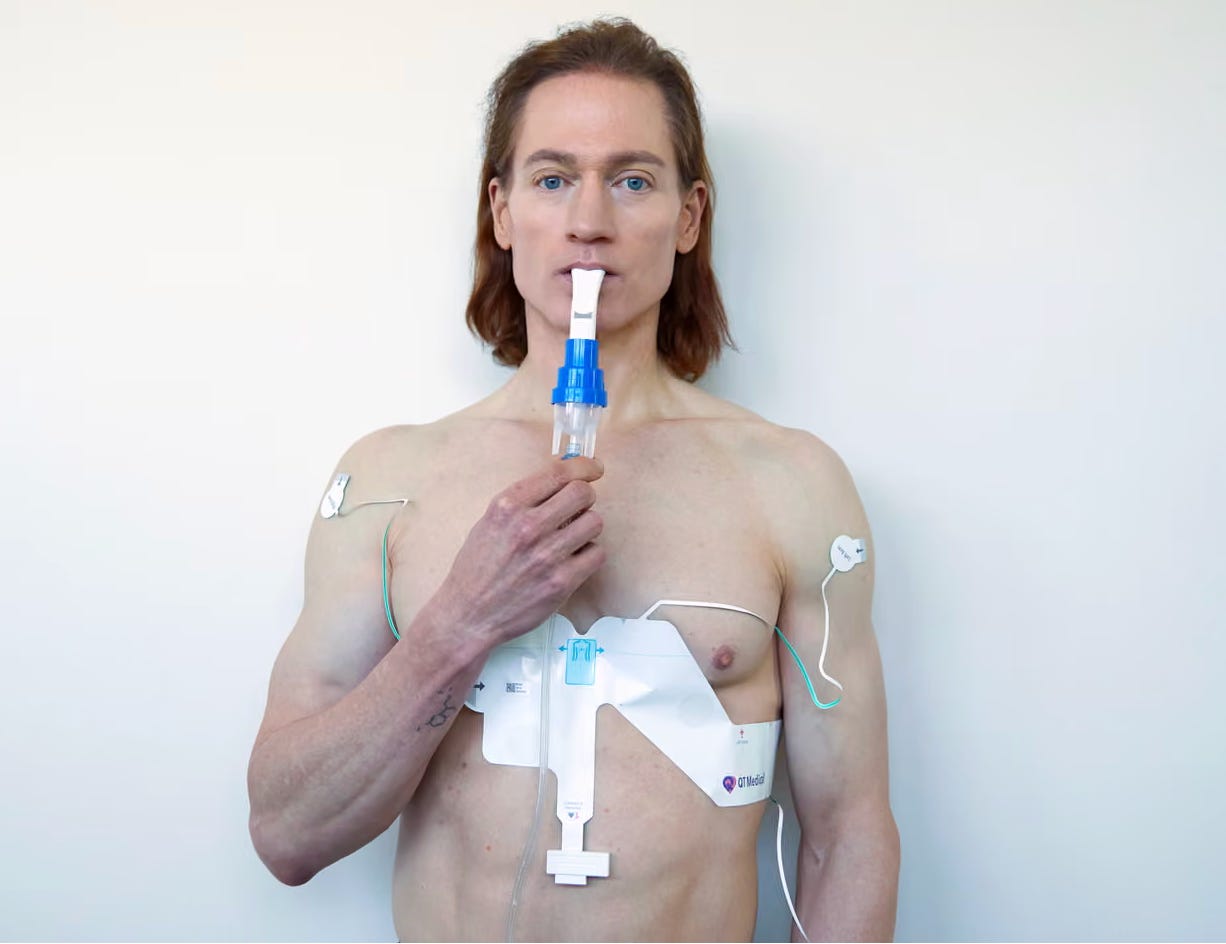
Without the testimony of individual experience, we fear being drafted into a collective destiny we didn’t choose by oligarchic power brokers uninterested in preserving our freedom of choice. In such a situation, self-determination would be an impossibility, the individual narrative a luxury enjoyed by a powerful few. The rest of us become handmaidens to the onslaught of the future, charged with performing our menial tasks and forgetting our pasts.
Sure, it may sound like the stuff of Bluesky discourse or an HBO series, but it also describes cultish behavioral authoritarianism and the violent encounters happening behind closed doors that feminism’s second and third waves have long protested against. Sexual assault does have a way of bearing one back ceaselessly into the past, whether one wants to be borne back or not.
And yet…it’s equally possible to build a regime of the past as of the future, to erect monuments to one’s hurt and force others to bow before them or risk social reprisal. If ultra-wealthy tech men like Bryan Johnson appeal to a disembodied, AI-assisted future to adjudicate the pain of the present, then activists who advocate verbal acknowledgment of the stolen land I’m sitting on as I write this are appealing to the past for the same.
And as surely as Bryan Johnson will depart this mortal coil along with the rest of us, there is no speech act capable of reversing the colonization of the Americas. There is no diverse hiring policy that can retroactively correct the course of human history, no book deal that will banish an assault from memory, no staff writing job that, once occupied by a queer woman of color, will somehow result in Harvey Weinstein never having been born.
We personal essay confessionalists were right to think that the past ought to be grappled with through individual testimony, that the body has a whole lot to do with how we’re received in space. But we were wrong to think that justice can be extracted from symbols and speech-acts, power grabs and pile-ons.
It’s equally possible to build a regime of the past as of the future, to erect monuments to one’s hurt and force others to bow before them or risk social reprisal.
If our vertiginous present is refreshing as quickly as Jia Tolentino’s feed, how can we expect it to deliver us from the injustices of the past, let alone the crimes of two minutes ago? Could it be the obsession with “fixing” injustice that finally broke our brains? Could it be all that good praxis, that increasingly rigid identitarian thinking, that transformed our equity-focused project into something not only leery of real inclusion and understanding, but turned resolutely against them?
I should know. I tried being a white man for three years, and it didn’t go as planned.
*
I certainly ticked every diagnostic box. Yes, I didn’t like how I felt in my body. No, I didn’t enjoy the performance of femaleness – in fact, its expectation felt like a violation. Yes, I was queer and eating-disordered and profoundly depressed and a little neuroatypical: all common comorbidities, as I’d learned both online and IRL.
Except, hold on, “comorbidity” is too medical, too pejorative a term to use here. Let’s say these were axes of my identity, symptoms of my uniqueness, to be advertised in my online bios and identified as sites of #resistance. I had already been systemically victimized because of these axes, which made me strong (if perpetually beleaguered) and therefore more likely to survive the rising tide of neofascism swelling around me.
The rights of all human beings to bodily autonomy and self-determination have always been core features of my belief system, and always will be. Had I become pregnant without wanting to, I would have gotten an abortion. Upon understanding that I’d become a woman without wanting to, I pulled the plug on my gender.
Yes, and…what did I want? My desires felt less political, less historic, less poetic than what I didn’t want. I wanted to stop spending all my brainpower figuring out how to get thinner. I wanted to unself-consciously flirt with other women instead of responding to the flirtations of men. I wanted to remove the firewall that seemed to prevent men in the academic and literary worlds from taking me seriously. I wanted to be less goddamn sad.
I was a trans man. The very prefix announces a bodily “before,” a turbulent past that had delivered me to my present. In other words, I was a walking personal essay.
I became, via speech act and gender-affirming healthcare, a white millennial man in the summer of 2021. While DEI may have bottlenecked career opportunities for my kind, it had done nothing to decrease the social cache of white maleness. I was invited to book festivals and offered speaking engagements. I was taken more seriously by writers and scholars alike. The novel published under the name Rafael Frumkin sold better than the one published under the name Rebekah Frumkin.
I had pink hair, a bridge piercing, and a high-pitched voice: I was far from unclockable. But I still felt relieved. And other people seemed to share my relief. I just made more sense this way. Now we could all dispense with the stress of having to understand me as a woman. We could scuttle the past, refer to my “boyhood,” focus on the bright future ahead, my ongoing delivery from dysphoria.
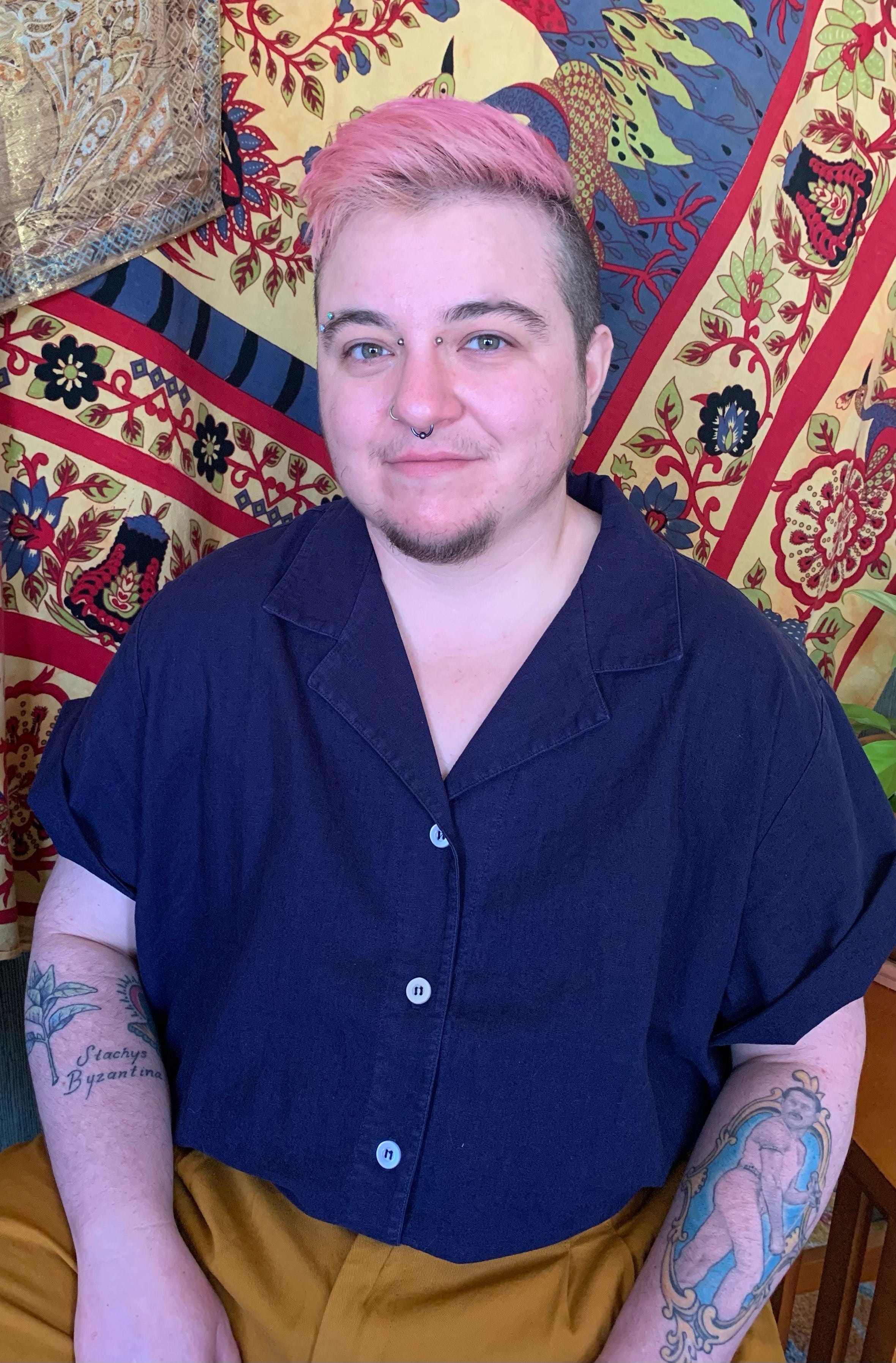
And yet…there was no amount of cheerful goodwill, pronoun-correction, or burying my past that could change the fact of how I’d arrived at manhood, nor the type of manhood I’d arrived at. I was not the same as a Bernie bro named Kyle. I was not a heterosexual dude who enjoyed playing Fallout 4 in his basement, nor was I someone who’d grown up putting gum in the hair of girls I liked. I never played football to learn teamwork and discipline. I would never be at risk of building a goon cave, nor of chasing the perilous high of the “goonstate.” I would never recall memories of my father telling me to “man up and stop crying,” nor of getting beaten in fights with other boys. I didn’t feel seduced by the rhetoric of podcasters in the manosphere, nor did I spend years loyally imitating the prose of Ernest Hemingway or the poetry of Charles Bukowski.3 I didn’t think to myself, as the main character jokingly does in Torrey Peters’s novella “The Masker,” that I was forfeiting my chance to become President of the United States by transitioning – I didn’t imagine transition suddenly gave me a shot at it, either. It would have been delusional to think otherwise.4
I was a trans man. As in transfer, translate, transcontinental. Across, beyond, through. The very prefix announces a bodily “before,” a turbulent past that had delivered me to my present. In other words, I was a walking personal essay.
It was not a lack of access to gender-affirming healthcare nor the adversity of living as a trans person nor a sudden heel-turn away from self-determination – mine or anyone else’s – that ultimately burst my bubble. It was trying to maintain the impossible balancing act of both having and not having a past. My gender identity began to feel like yet another performance to be rigidly kept up. I stopped taking testosterone. Shock, insurmountable obstacle, revelation.
And what did I do, when I stopped living as a man? When I stopped living as a woman whose future was determined by the identity markers of her past? I started writing a book about it.
*
This is part one of a two-part essay. If you enjoyed, check out part two here!
Want to write essays, fiction, or humor with me? Check out my winter class offerings below:
Who Gets to Live a Creative Life?

Some things I believe about writing and fear, and some classes designed to address those fears.
"Raf's novel incubator class is a fun, productive and unique experience. I've taken a lot of writing classes, including MFA workshops, and this got me to approach the process in a completely new way. I took an older project out of mothballs, and the class helped me locate the parts that were really working. I'm excited to move forward with a fresh perspective." - Carrie P.
I like to joke that if Moses had been a very online millennial woman, he would have responded to the burning bush not with “Here I am” but “I Floated Down the Nile in a Literal Papyrus Basket and Lived to Tell the Story.”
And no doubt worn by uncool older white women who haven’t smoked as many blunts or rolled as hard on MDMA as Jia Tolentino.
I will, however, cop to writing a few stories in imitation of David Foster Wallace. If that alone didn’t give me gender dysphoria…
Nice try, Conclave.
Loved this! Your use of the word "testimony" reminded me of Vivian Gornick's essay about how Holocaust testimony opened the gates for memoirs by women and black writers:
"Throughout history, liberationist movements, one and all, have relied on the strength of those who have volunteered to place the flesh of lived experience on the skeleton of collective demands. In our own time, and with our own movements, it was practically foreordained that naked testimony would carry the day for women and Blacks and gays, as ours is a cultural moment when the authority of words like “based on a true story” have edged out the authority of works that originate in the imagination."
https://yalereview.org/article/the-power-of-testimony
In this peak personal essay era I followed a lot of adoptive parent blogs and many times viscerally recoiled at their openness (to put it nicely). They shared about themselves and the most personal vulnerable moments of infants and children, who were at a certain point strangers to them! It seemed scandalous to me. Still, I read them.
Either because of my (old) age or just personal temperament, the entire era of personal essays left me feeling uneasy. How can they just - share - so much? I have always been an aspiring writer but could not contribute. I figured I was governed by shameful shame and too uptight.
Could include mattress girl in this too, the performance art version of the personal essay.