

On Being Allowed to Finish
Life of a showgirl, death of a villain

I. Who Misses the Old Kanye?
This, dear reader, marks the third and final essay in the series I’ve nicknamed the Swiftiad. The arc that began with a Tortured Poets Transition Essay and then escalated with a Swift-As-Job-Quitting Soundtrack Detransition Essay (also anthologized in Salukis on Swift, a collection of smart, funny, incisive essays on Taylor Swift from SIUC students that I edited as a goodbye to all that[1]), has at last reached its denouement with what you’re about to read. What better time than autumn, the season of pumpkin spice and atonement, for the contemplation of a long plot’s timely resolution? The moon is half-full, Taylor Swift is engaged to a footballer and about to release her deliciously Ophelian Life of a Showgirl, and Kanye West’s last remaining tether to reality seems to be his ongoing ability to create transcendently good beats. Let’s revisit the 2009 VMAs!
For whatever fraction of Cosmic Cheeto readers either too young to remember the 2009 MTV Video Music Awards or too old to care about them, let me apprise you of why this particular awards ceremony was such a pop cultural flashpoint. Taylor Swift, then eighteen years old, was at last entering the arena of pop, a category as broadly construed[2] as “literary fiction” or “woman-identified woman.” No longer content to remain country music’s child prodigy, Taylor had begun her country-pop ascendancy with the release of Fearless, and at these particular VMAs, it was Fearless that was being rewarded. Specifically the music video for “You Belong With Me,” a song that’s as robust an entry as any in her early catalogue, and notable for its expert admixture of country tropes (the longform first-person storytelling[3], the twang, the lovelorn heterosexuality) and pop accessibility (the earworm of a bridge, the egg-on-her-face confessional, the lovelorn heterosexuality). In the video, an Urban Outfitters Nerd Taylor competes with a Mean Girl Taylor for the affections of an overgrown Cole Spruce-type. Both Taylors are portrayed with equal amounts humor and try-hard clumsiness, which is part of the video’s unaffected charm. Combined with how damn catchy the song is, a series of rippling reactions I’ll call the Swiftian Head Fake ensue: a hot girl who is – what? – not doing a particularly good job of being hot,[4] and she’s singing about – whaat?? – being a lovesick dork and the song is – whaaat?? – pretty damn good.
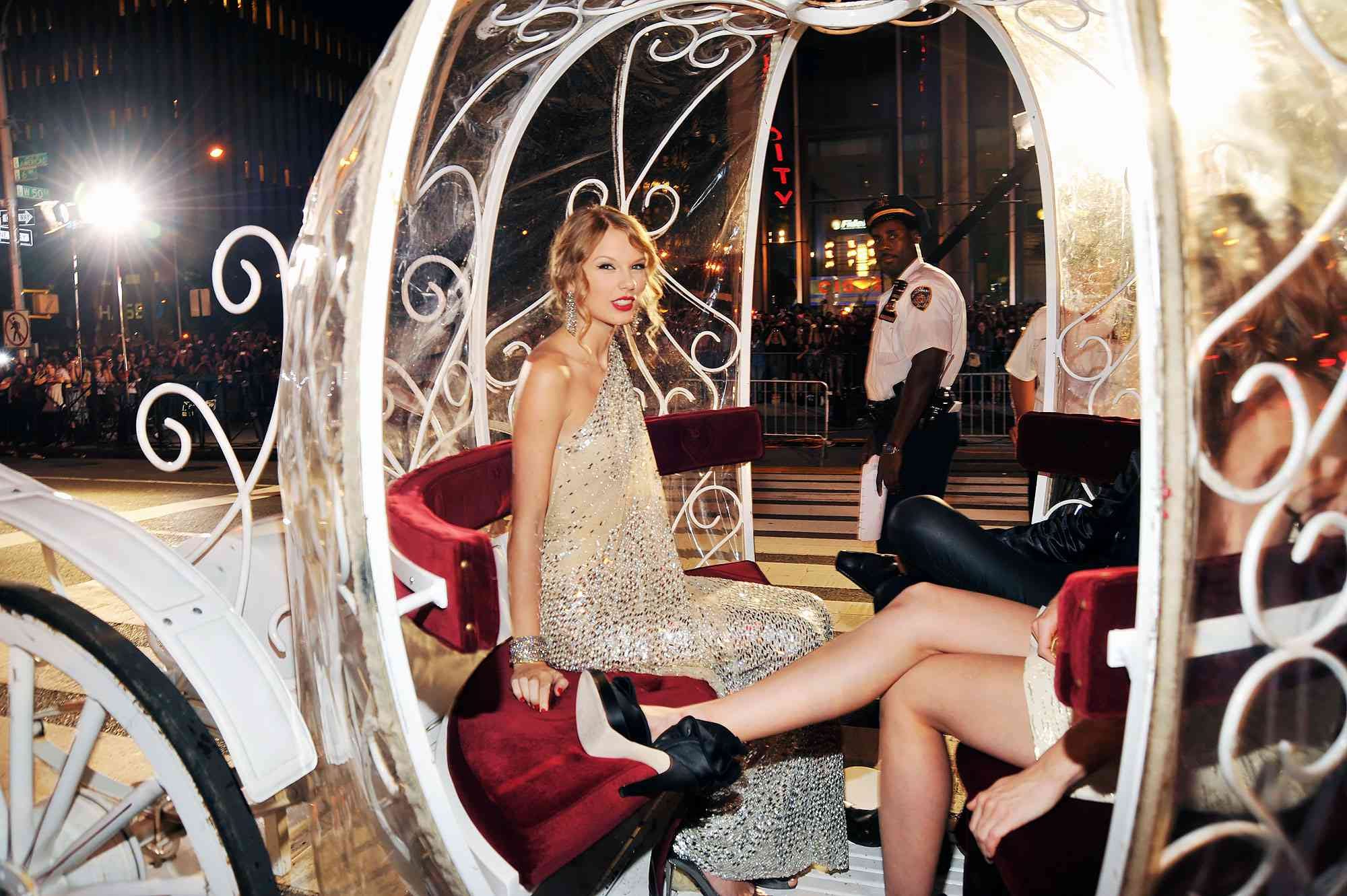
What? indeed. But before you can finish un-faking your head, there she is, a Pennsylvania princess arriving to the VMAs in a white horsedrawn carriage and a floor-length silver dress. Who else could make an entrance as enchanting as this, the red carpet commentators wonder aloud? No one except Taylor Swift. Was this always true? Who is Taylor Swift? On that night in 2009, these questions didn’t matter. Once she’d stepped out of her carriage, it seemed we were destined to know her.
Though another young genius had just walked that same red carpet, he might as well have been walking the terra infirma of a distant planet. There is a simple story one could tell about Kanye West’s condition that night: he arrived to the VMAs swilling Hennessy, his behavior was already so aberrant the red carpet commentators were told not to joke about it, Amber Rose looked visibly uncomfortable next to him in her snakeskin bodycon. All this spelled chaos and doom, and Kanye didn’t seem to care.
But let’s not forget the backstory. He had just released 808s and Heartbreaks the year before, had floored secular America with Gold Digger and non-secular America with Jesus Walks. He had introduced the white boys at my high school to popped collars and shutter shades[5] and rigorously – even rapturously – disassembled the form of hip-hop like a complex piece of origami. His producer’s mind was capable of transforming the most monotonous Jay-Z track into something that sounded like it was vibrating on a divine frequency, and his own tracks into things that genuinely seemed to vibrate on several divine frequencies. Sneer if you will at the Kevins and Gavins who drove the streets of their whitebread suburbs blasting Late Registration from their moms’ Subaru dashboards, but you’d be hard pressed to admit they didn’t have a point. Who needed the screechy caterwauling of punk, the lo-fi mumbling of indie rock, the tired drama of emo, when you could have this? Kanye West was a genre disruptor. He had a big ego, sure, but he was right to have one. Kids who never would have listened to A Tribe Called Quest or Nas, who never would have known the first thing about 70s gospel or Motown or who Fred Hampton was and why he’d been murdered, now studied Kanye’s liner notes like rabbinical scholars. What I’ll call the Westian Mélange – nerdiness, peacocking, soft Sinophilia, astounding beats, pointedly speaking truth to power, abortive radicalism, a Black Panther’s soul in a conspicuous consumer’s Maserati, an unparalleled aesthetic eye, Jesus, and loads of confessionalism – was now mainstream. And he hadn’t even released his beautiful, dark, twisted opus yet.


Less public was the loss of his mother, Donda, two years before. Once chair of the English department at Chicago State University and ex-wife of photojournalist and Panther affiliate Ray West, Dr. Donda West abruptly became the mother of one of the most famous people alive. She would get cosmetic surgery, as many women have when they become the sudden object of intense public scrutiny, and she would die of post-operative complications from that surgery on November 10, 2007. Her socially awkward and bluntly outspoken son was 30.
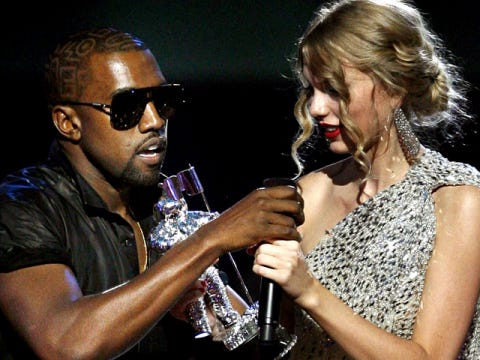
If it was some kind of twisted kismet that landed Kanye in the front row at that particular VMAs (apparently he was moved from the back because producers were dissatisfied with how few men were sitting toward the front of the auditorium), then grief may have played a partial role in landing that Hennessy bottle in his hands. When Taylor, a teenager already well on the road to superfame, assumed the stage to accept her award, it seemed an uncontroversial and highly deserved choice. Yes, Beyoncé did have a fantastic music video, but she was an old pro by then, more likely to win Video of the Year,[6] so why not let this brilliant young dork take home her astronaut statue? What would a win for Taylor – or Lady Gaga, or Kelly Clarkson for that matter – detract from, exactly? Which was the question many of us were wondering when the cameras cut from Taylor excitedly thanking the crowd for her “chance to win a VMA award” to Kanye suddenly onstage, somehow holding the microphone she’d been speaking into just moments before, saying like a manic antagonist in a nightmare that should have been impossible: Yo, Taylor. Imma let you finish —
And now I’m sure you know the rest of the story. Kanye didn’t let Taylor finish. He left her deflated onstage at what ought to have been a highlight of her burgeoning career, casting around awkwardly as the entire audience booed him. Beyoncé wept. Pink pulled Kanye aside to dress him down, and Barack Obama called him a jackass. Taylor – still a kid, lest we forget – confessed to being a Kanye West fan[7] and lamented being pulled into a complex drama of which she wanted no part. In an attempt to apologize for his out-of-pocket behavior, Kanye submitted to condescension from Jay Leno – a great humiliation in its own right – tearing up and struggling to speak when Leno invoked Donda’s memory. “I am a celebrity, and that’s something I have to deal with, and if there’s anything I can do to – to help Taylor in the future, to help anyone – I wanna outlive this thing. It’s hard, sometimes, so…” He trailed off as Leno offered him a fatherly pat on the knee.
What strikes me as I watch the VMA clip sixteen years later is how similar Taylor and Kanye appear to be. Not in terms of impulsivity – Taylor is measured where Kanye is (often disastrously) unfiltered – nor in terms of bluntness or provocation: Taylor was already riding the dazzling comet’s tail of global superstardom when she endorsed two Tennessee Democrats in 2018, while Kanye had just begun his career when he called the president racist on national television. The way in which Taylor and Kanye are similar has to do, ironically, with the strange condition of being a singular talent: both have the lightning-in-a-bottle ability to produce art that seems hierophantic, and there’s an unpolished earnestness to both of them, a nerdiness, that can certainly be coached and safeguarded against and sued over but never completely scrubbed away. Say what you will, but the silver-clad singer-songwriter trembling onstage in 2009 was no less an encyclopedia of music, art and culture than the hip-hop artist with the elaborate fade interrupting her.
This, reader, is why it’s all hurt so bad to watch what’s happened in the years that followed. Kanye’s bizarre provocations -- the creepy and aggressive lines in “Famous,” the song’s pornified music video, Kim Kardashian’s instigation of a juvenile online smear campaign – and his frightening public journey down a paranoid rabbit hole of mania, myopia, and Farrakhanian antisemitism. Taylor’s attempts to stay above the fray while making art about it (i.e. speaking her own truth to power), her stratospheric ascendance, and the vitriolic backlash. And I’m talking not just about the spittle-flecked misogyny and everso informed accusations of vapidity and talentlessness – these are tired canards that us Swifties are well familiar with by now, easily recognized and dismissed as the unserious, time-wasting objections that they are. I’m talking about something far stickier, something that’s proven difficult to outrun for both Taylor and Kanye alike. At various points in this “feud,” both have stood accused of weaponizing their victimhood as part of a grander, self-interested set of calculations – gambits for money, relevance, power, etc. And in our identity-and-equity-obsessed age, this is the sort of charge that carries with it grave moral implications.
Before I take you on a tour of these accusations, I have two disclaimers to make. First: like the other essays in the Swiftiad and any other piece of pop culture criticism I may publish on here, this is not an essay about Taylor and Kanye as individuals, but as symbols. I don’t purport to know the thoughts that passed through Taylor’s head when she announced her engagement in a style that an essayist in the Point amusingly (and accurately) described as “Mormon blogger circa 2012,” nor do I know what Kanye West was thinking when he made a music video called “Heil Hitler” in which he bemoaned losing custody of his children. But I do have a sense of what each of them symbolize in our broader culture, and the ripples of affect that have resulted from their music, their on-the-record statements, and their public-to-a-fault lives.
Second: I’m a rare fan of both Taylor and Kanye,[8] which is either a massive conflict of interest or a rare superpower that uniquely qualifies me to write this essay. Truth be told, I think it’s neither. It’s an ability to let paradox sit in front of me like a stack of unopened mail on the kitchen table: as long as it’s not too bothersome, I’m fine with it being there, and I’ll get to unpacking the implications when I have the time. Which, I suppose, is right now.
So, let’s tunnel deeper, shall we? We’ll explore the strange cases for both Taylor and Kanye as victim-oppressor. And paid subscribers will get to learn what the dimensions of this feud mean for our polarized political climate and the deterioration of the American left.
Ready for it?
II. The Accuser and the Innocent
Speak Now was released in 2010, and “Innocent,” its eleventh track[9], would introduce an ever-growing fanbase to yet another Swiftian Head Fake. Wait…is this is an entire song about a public humiliation that befell this artist a little over a year ago?
The answer was an unequivocal yes. Taylor Swift processes her wounds publicly and fast – hence the Easter eggs, the “lore,” the accusations of man-eating. This is just the way it is, something philosophers might describe as a brute fact. Why do we exist on a rock in space? We just do. Why does Taylor Swift quickly metabolize the most cringe-worthy moments of her life into chart-topping, emotionally earnest music? She just does.
Sometimes, that music is prescient in addition to being earnest. “Innocent” is not just a song about forgiveness, but an insightful work of creative nonfiction about how overwhelming it must be to be Kanye West. His “firefly catching days” – days in which Donda was alive to delight in his sparkle – were no doubt easier than the reality he was contending with. He was a visionary and a firebrand and a very famous person who seemed profoundly at odds with being famous. He was 32 and still growing up.
Irrespective of the freaky accuracy and Cassandra-like foresight of “Innocent,” a concept of Taylor began to materialize in the American collective consciousness. She was a sweet, frail bird who always takes the high road. She’s just doing her best, and men are always running roughshod all over her. She is the blond, white, lovely victim of a brutish, volatile black man.
No sane person intends to step into the Grand Guignol of American racial politics, and to be thrust into it is a maddening indignity. This is a point James Baldwin made to great effect in his criticism, and which Kanye makes in much of his discography as well. But regardless of what Kanye-the-individual and Taylor-the-individual lived through up on that stage in 2009, half the country would see her as the besmirched victim of an uncouth jerk. This, like the alleged jerk’s rap music, was a disruption of tradition – a tradition worth fighting for. When Taylor blondely took the stage to sing about Kanye as a youthful “innocent,” the ghastly parallels to murders like Emmett Till’s were there for anyone searching for them.
Then Taylor-the-symbol fell into the hands of the neo Nazis and the alt-right. Quotes from Mein Kampf were Photoshopped over her publicity photos. The Daily Stormer referred to her as an “Aryan goddess,” and marveled at her ability to exude “1950s purity, femininity, and innocence.” But in less extreme corners of the internet, the myth had just as much currency. Much ink was spilled over the alleged weaponization of Taylor’s victimhood. In fact, this line of criticism would lend potency to claims about her lack of talent. All she does is look pretty, complain about men, and keep stirring the pot so she can keep getting rich. This was why nobody wanted to date her! This was why her fans were just a bunch of emotionally regressed, self-righteous Disney kids wallowing in their fake pain! This was why she had the audacity to become an ethically indefensible billionaire and then not give any of her money away to Gaza!
And given the brute fact of Taylor’s creative life – humiliation to composition to chart-topping albums – it would seem she had indeed created a perpetual motion machine capable of generating both profits and moral unimpeachability in endless amounts. And it would seem, too, that hers was a cultural perch not so easily occupied by women who don’t look like her. Could a young Rihanna or Nicki Minaj have made such claims to victimhood or open-heartedness – better yet, would their teams have allowed them to? Was there not something unfair about Taylor’s success, then? Something less than egalitarian? Was it not real musical genius and grit that she’d fashioned into an empire, but whining and whiteness?
Among the things that happened to Kanye West was a kind of high-tech racial violence, but it would be foolhardy to say that this happened at the hands of a single fellow celebrity-symbol. There have been darker forces (societal, historical) at work on him, and he’s put a good deal of work into his own undoing as well. If anything, what these victim-oppressor impressions of Taylor expose is not some grand unified theory of her chauvinism and undeserved success, but the tendency of our discourse about cultural and political symbols – the decisions they make, the art they create, the history that unfolds with them – to lose the plot by several miles.
III. “I Made Taylor Swift Famous”
In the final scene of the music video for “Look What You Made Me Do” from her 2017 album reputation – an album that would form the soundtrack to many a comeback, including my own – a Greek chorus of Taylors assembles to nitpick one another. Country rock Taylor is informed that she’s fake, and “You Belong With Me” Taylor is told not to look so goddamn surprised all the time. When 2009 VMAs Taylor calmly voices that she’d like to be “excluded from this narrative,” the other eras – or shades, if we’re sticking with the Greek tragedy metaphor – snap back at her: SHUT UP! But this would have been an entirely reasonable request to make of Kanye West, who had by then gained a reputation less for speaking the truth than for starting shit.
The easiest charge to level against Kanye is one of excess. He was the bookish child of bookish parents, a hip-hop Mozart steeped in political criticism and spiritual lyricism. It seemed for a time that he could be a guiding light to a generation of young black men. In 2005, during a fundraiser for the victims of Hurricane Katrina, he spoke these immortal words on television: “George Bush doesn’t care about black people.” That same year, he gave an incredible interview on MTV in which he called on other hip-hop artists to address their homophobia.
But by the time Kanye was winning four Grammys in a single night, it was clear his would not be the consciousness-raising project of an Amiri Baraka or a Tupac Shakur. Which is not to say he ever stopped trying to raise the public’s consciousness about the experience of being black in America or the soul-balm of spiritualism. His attempts were just stymied by his own hubris.
Bitches, money, Benzes. Even as Kanye was warning against the reduction of the black counterculture to yet more soulless materialism, the obfuscation of history, and sexual violence against women, he seemed obsessed with material demonstrations of his ever-expanding wealth and content to hold women as a category – especially those who were or could be sleeping with him – in contempt. He was already an ethically indefensible billionaire before Taylor joined that income bracket, and if there was any fan pressure on him and Kim to donate $5 million to UNRWA instead of spending the same amount on a golden toilet, I saw none. As big a fan as I remain of My Beautiful Dark Twisted Fantasy, I can’t listen to “Blame Game” with a straight face – the song’s misogyny lands somewhere between “posturing anime fan” and “incel fantasy.” And I don’t care about any supposed “dual meaning” to that bleach-on-the-t-shirt bar in “Father Stretch My Hands Pt. 1.” It’s just bad. It’s very, very bad. Taylor Swift’s worst lyric is leagues better, and she wrote it when she was a kid.[10]
The victim-oppressor portrait that emerges of Kanye-the-symbol is of a dunderheaded loose cannon, a hypocrite and sellout, a person who had the ability to change the cultural conversation on topics like race and class but squandered it all on personal enrichment and made an ass of himself. That such a person would go out of his way to be misogynistic to a talented industry newcomer and then turn around and bemoan how difficult it was to be a “less-than-perfect black celebrity” was entirely plausible, though one had to admit he did have a point about the nature of public scrutiny differing with the race of the scrutinized. But by the time he was informing the TMZ newsroom that “400 years of slavery was a choice,” he’d lost even his most diehard sympathizers. Fallen from grace entirely. No longer a soothsayer or a disruptor but a tragic figure at best, a traitor at worst.
In this sense, it would be easy to say not just that Taylor had the moral high ground but that she deserved it. Kanye West is a lunatic, a chauvinist too rich to be deplatformed, a nuisance whom everyone is by now tired of seeing. How saintly of Taylor to have written “Innocence” all those years ago – she’d turned the other cheek, and he never earned it!
Like the charges alleged against Taylor-the-symbol, these charges against Kanye-the-symbol also miss the point. That he has bullied Taylor, made asinine and highly regrettable statements and music, and been a bull in the cultural china shop is all but incontrovertible. But consider the fact – voiced by Taylor herself in Miss Americana – that one can become socially and emotionally “frozen” at the moment when one first becomes famous. Consider that Kanye West first became famous in 2005, lost Donda in 2007, and doesn’t seem to have updated his views on gender and family since. He’s forever the grieving young momma’s boy from Chicago’s South Side, throwing his lot in with hyper-patriarchal Christianity and seeking to regain the favor of a father who’s had a troubled relationship with what he sees as the counter-revolutionary elements in his son’s work. Once an expansive thinker, it was precisely this admixture of grief and pride that has made Kanye increasingly defensive and inflexible, more susceptible to public outbursts and external coercion, more likely to drink and spout the Kool-Aid that is the virulent antisemitism running through certain strains of black radical thought. Throw drug addiction into the mix and you’ve got at least one plausible explanation for something like the “Heil Hitler” video.
“Innocent” was masterful because it posited an explanation for Kanye’s outburst that sought neither to blame nor excuse him, but to understand him. Unfortunately, in a political climate as obsessed as ours with both correcting and perfecting history, the song’s intention remains illegible to a combative republic.
IV. I’d Like to Be Excluded from the Geist of History
By now I’m sure you’re wondering how I’m going to link a sixteen-year-old feud between two celebrities to the withering of our country’s political discourse and the attenuation of the American left. Well, reader, it has to do with something called historical materialism, which always seems to rear its head wherever talk of moral superiority, antisemitism, and the “Aryan race” abound.
Keep reading with a 7-day free trial
Subscribe to The Cosmic Cheeto to keep reading this post and get 7 days of free access to the full post archives.