

Trauma Jocks
Go ahead and victimize me, bro! You'll see just how good I really am!

Should I start a new essay series called Untimely Film Criticism? Should you conquer your fears and publish a series of your own? Only time will tell ;)
Discussed below: The Odyssey, The Devil Wears Prada, the social currency of trauma, Virgil’s Sinon vs. Christopher Nolan’s Sinon, moral superiority and hijacked art.

I recently watched both Devil Wears Prada films for the same reason one might return to sleep in hopes of confirming the contents of a particularly unnerving fever dream.
You almost certainly remember this movie from 2006: Anne Hathaway plays a fledgling journalist hired to work for Meryl Streep, who plays a version of former Vogue editor Anna Wintour so joyless and angry she appears to have survived combat. Needy Anne wants to do Big Girl Journalism and hopes that this job at the dumb fashion magazine is just a stepping stone; her angry, cruel coworkers teach her not only that she’s horribly fat, but that their petulant little love crumbs were the real friends she most needed to make along the way.
Twenty years later, The Devil Wears Prada 2 is almost exactly the same as the first. I mean that it’s nearly the same film shot-for-shot, with a script that may have resulted from feeding Claude the prompt “The Devil Wears Prada again but some time has technically passed.” Anne’s Andy Sachs is head-hunted for Runway when she gets laid off from her Big Girl Journalism job; Meryl’s Miranda Priestley is once again cold and dysfunctionally cruel; again, Andy realizes that contorting herself into knots to please this miserable woman is all she ever needed! Now, she can stop girlbossing herself to death and start dating an Australian real estate developer.1
I’d wondered whether the first film had sincerely asked us to look at 22-year-old Anne Hathaway and conclude that she was unstylish and a great candidate for Fen-Phen. (It had.) I was not surprised that the second film was cynically engineered slop, but I was surprised by the arresting nugget of truth at its center: an eager-to-please millennial woman returning to the site of her greatest professional humiliation in order to relive it in its totality. Now here’s a story I’m quite familiar with.

You’re wondering why I’ve drilled this deep into a film franchise based on Anna Wintour fan fiction from 2003. I’m wondering why it feels so right, being wronged? Why is the ritualized performance of victimhood not just an erotic impulse but a sociopolitical one – and a highly valued impulse at that?
I’m going to use the term “trauma jock” to describe the protagonist of the following plot arc: a wronged person returns to the site of her original harm in order to contemplate her moral superiority and expose the foolishness of her antagonists. The trauma jock’s story is not a simple revenge plot – if it were, the bulk of the narrative wouldn’t concern her re-victimization. And it’s somewhat less than a trauma plot, because that one posits a present handily explained away by the circumstances of a very different past.
Instead, the trauma jock’s arc is a little bit of both these things. She is returning to the site of her oppression in order to expose the cowardice of her oppressors. That site can be physical, digital, ideological, or some combination of all three. That exposure – otherwise known as her revenge – can only be wrought through the ritualized repetition of her pain.
Not all trauma jocks are doormat-martyrs like Andy Sachs. Many choose to martyr themselves differently. There are those who, in true jock fashion, return to their hometowns (or home-offices, defunct Twitter accounts, etc.) in order to re-enact their suffering as a labor of political heroism. Once a gawky loser kid, now an adult courageously hip to systems of oppression. Once a sad weirdo adrift in the conformist ‘90s; now an aggrieved member of a protected class.
I am speaking, unfortunately, of Elliot Page’s 2023 trans homecoming film, Close to You. I am a lifelong fan of Page’s and think he could auteur the hell out of an interesting project. Alas, Close to You was not it.2
The trauma jock’s revenge can only be wrought through the ritualized repetition of her pain.
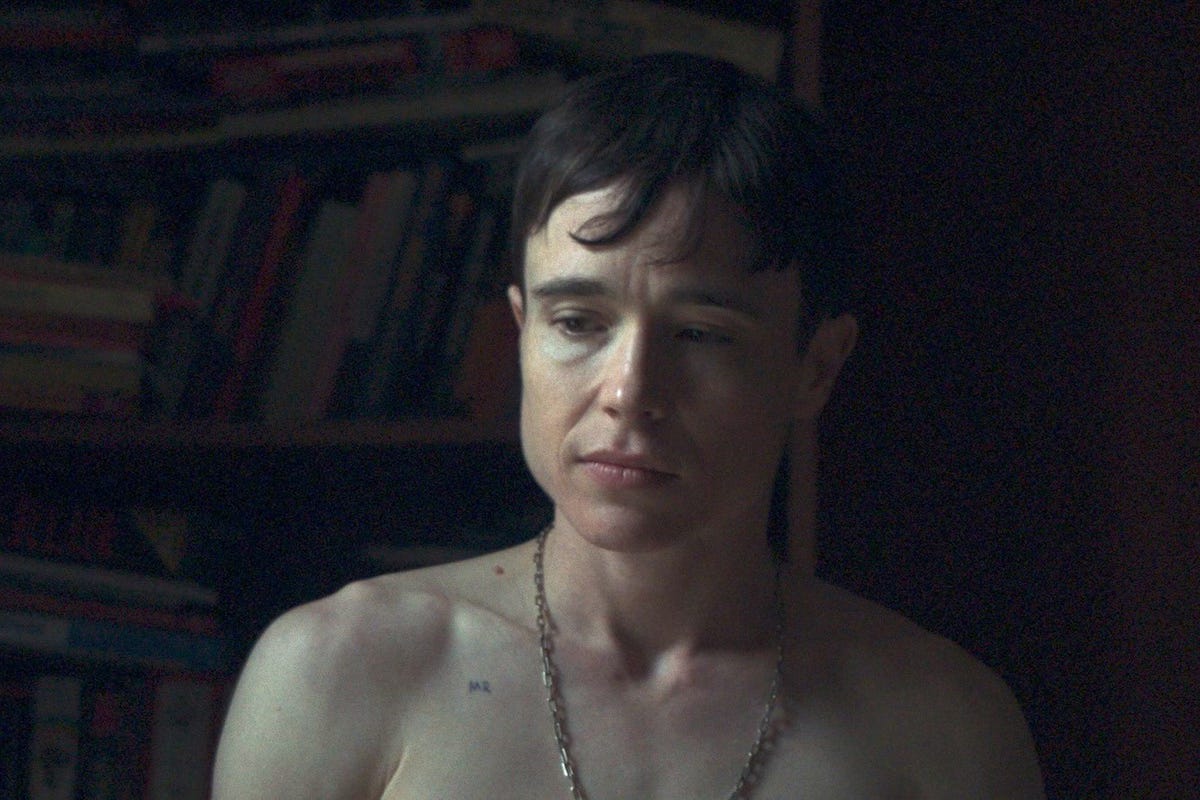
Page plays Sam, a trauma jock returning to suburban Ontario for the first time since transitioning. The occasion is apparently Sam’s father’s birthday, but one wouldn’t know it for how laser-focused on Sam everyone is. Is he okay? Is he eating well? Sorry about the misgendering, Sam! How are you enjoying your radical queer sublet? We are so worried about you literally all the time!
They are an anxiously attached professional managerial family, and to his credit Sam seems to recognize the real love beneath all the hand-wringing. It’s not until a Straight White Antagonistic Man (SWAM) emerges in the form of Sam’s new brother-in-law that Sam’s dialogue starts sounding like a strongly worded Tumblr infographic. Does this asshole understand the emotional labor he’s demanding of Sam? Does he understand his literal unwillingness to acknowledge Sam’s right to exist?
The SWAM is indeed a jerk, and an unrepentant one. But that doesn’t make it any more pleasant to watch an expansive and sensitive actor like Elliot Page attempt to breathe life into such a bitter, high-strung character. Who is this shrill, bedraggled little guy who keeps making the unconvincing claim that he’s “happier than he’s ever been” while looking utterly depleted of dopamine?
I believed every minute of Sam’s suffering in Close to You – indeed, I’ve lived my own version of it. It was the sad spectacle of his trauma jocking that made the film so hard to watch. One would hope that the demanding and expensive process of “becoming himself” has helped Sam understand that the human experience is a wild and funny thing, that finding a way to detach desires from outcomes is the surest way to ameliorate suffering, and that his life is bigger than the sum total of all the homophobic bullying he’s endured. Surely by now he’s learned that there are challenges far greater – and more personally rewarding – than tangling with the sort of dude who wears a $400 watch and pays for Pornhub Premium?
But there’s no molehill too small for Sam to die on. He abandons his father’s birthday in a huff, then sleeps with the high school ex who was pressured out of like-liking him by the ambient homophobia of ‘90s suburbia. Because Sam is super good at being so authentically himself, the high school ex decides to abruptly leave the life she’s built with her husband and throw her lot in with Sam, an adult who sweats bullets over baby boomers’ pronoun usage and purchases his father a generic tie for his birthday.3
The SWAM is never anything more than a bigot on the wrong side of history. Sam’s family are cowards who receive their comeuppance for attempting to broker peace between them, and Sam is a sanctified victim. The bad people kept being bad, and failed! Queer love conquers all in the end! Of course, this is no more an example of psychological realism in fiction than Andy Sachs’s life-affirming joy in getting contemptuous Ozempic-ravaged rich women to smile. Instead, it’s the trauma jock’s fantasy endgame: he gets the girl and the moral superiority while the unwoke bullies are shoved into mental lockers and forced to think about what they’ve done.

It reminds me of another recent Page role: Sinon in Christopher Nolan’s The Odyssey. Sinon first appears not in Homer’s Odyssey but in Virgil’s Aeneid, where he tricks the Trojans into allowing a giant wooden horse full of Greek soldiers within their city walls.
Virgil’s Sinon is sneaky and deceptive, claiming he’s deserted his countrymen and that the giant wooden horse they left behind was a gift to the gods in exchange for safe passage home. But Nolan’s Sinon is a boyish naïf, a sacrificial lamb whom Odysseus deceived into believing the wooden horse was actually empty in order to ensure the invasion of Troy would go off without a hitch. Worse yet, Sinon’s only there in the first place because Odysseus let him join up with the Greek army in place of Antinous, a villainous SWAM now attempting to marry Odysseus’s wife. (Sidenote: Anne Hathaway’s Penelope is fortunately less of a girlboss at the loom than Andy Sachs would have been.)
The Odyssey is about what most Nolan films ultimately tend to be about: a man grappling with the dimensions of his own power, discovering how unwise it is to play god(s), concluding that perhaps it’s a bad idea for the human will to triumph quite as hard as all that. One could make an interesting case for Nolan’s Odysseus as a soul-searching sort of trauma jock, keen on exposing his own cowardice along with that of his enemies and countrymen. Only this ruminative, guilty Odysseus would be willing to visit the gate to the underworld and receive a dressing-down from Sinon that feels, for all the oomph of Page’s delivery, more like a single-note call out than a dramatic monologue.
In the trauma jock’s fantasy endgame, he gets the girl and the moral superiority while the unwoke bullies are shoved into mental lockers, forced to think about what they’ve done.
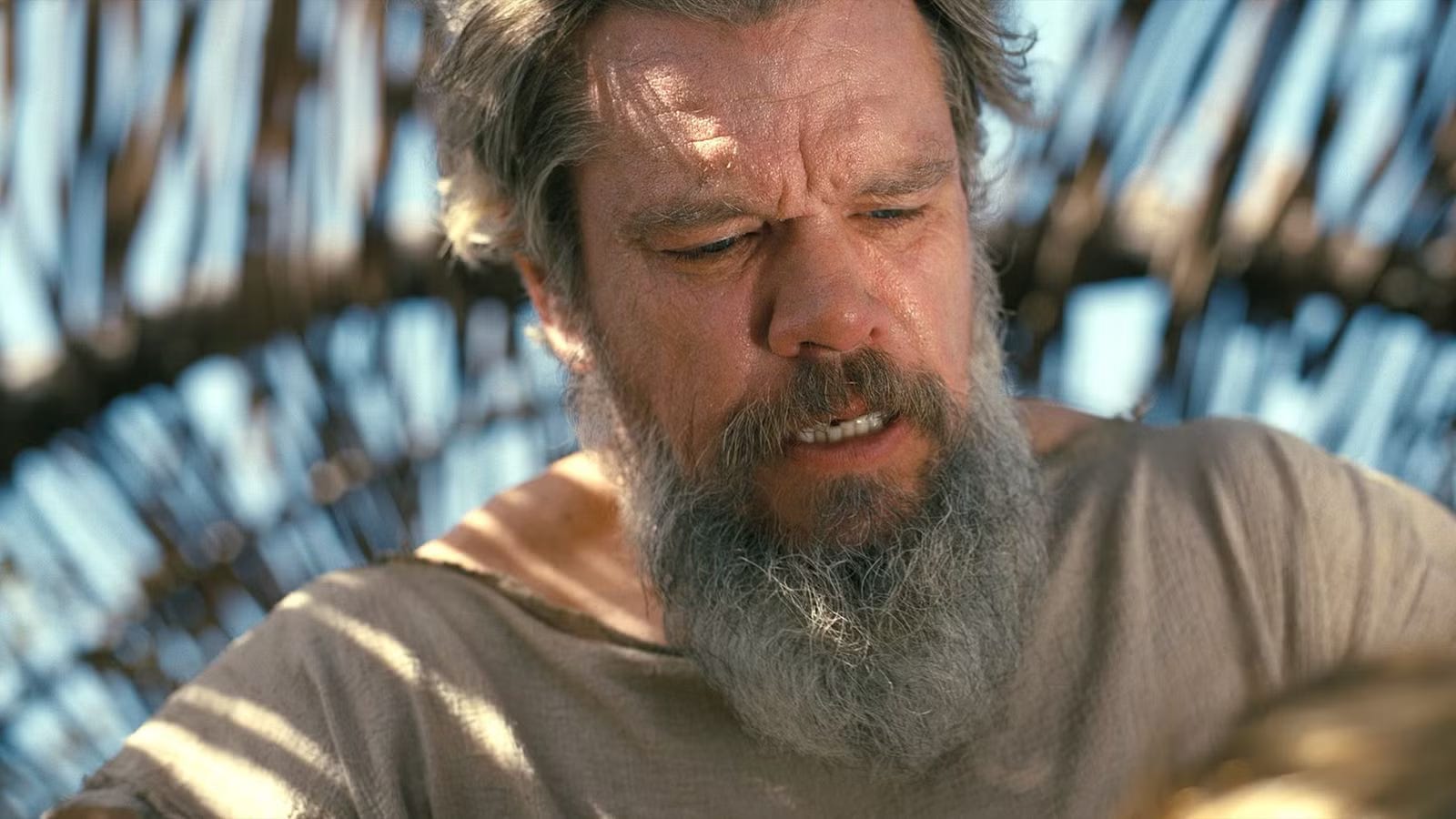
Sinon rages, demanding to know why Odysseus could deceive him and leave him alone on the beach to be murdered. Matt Damon’s Odysseus gets slack-jawed and watery-eyed, explains that the deception was what ended the war and that he was actually right next to Sinon when he died, just inside the horse. So Sinon wasn’t alone as he bled out after all! But Odysseus is still so sorry, he’s listening and promising to do better. Later on, he calls boyish Sinon “the bravest man I ever knew.”
Sinon is deservedly mad, but that’s also all he is. He has suffered and died and emerged from this otherworldly experience exactly the same boy he always was: betrayed, traumatized, sanctified. Unlike Virgil’s Sinon, he cannot tell a lie, he cannot be anything other than an aggrieved innocent, so thoroughly good and authentically himself, trauma-jocking at his unjust past from the mouth of Hades. And as Sinon does this, Odysseus gets to relive his wrongdoing through the eyes of his victim and be absolved. Like an Evangelical convert renouncing his sins before baptism or a white lady paying black and brown women lavish amounts to call her racist over dinner, Odysseus can expunge his badness – at least in part – by hearing Sinon out. Afterwards, he can return to Ithaca relieved of moral opacity, ready to do some trauma jocking of his own.4
The trauma jock’s arc appears dynamic while offering only an illusion of change. Watching the trauma jock relive her pain and enact her revenge from the carefully adjudicated redoubt of her moral superiority, we believe that we are witnessing progress. A true transformation. But what we are really witnessing is an individual journeying in place.
Given our current media landscape, I’m sure you can probably imagine a version of The Devil Wears Prada in which a blinking-back-tears Andy Sachs comes to terms with the fact that she’s an anxiously attached codependent in the thrall of a toxic workplace with no HR department to speak of. She sues the cerulean jodhpurs off Miranda Priestley, walks away with millions, and then grapples with the dimensions of her power.
But what about the version where Andy realizes that the petty struggles in the Runway office were simply an – ahem – runway to something altogether different? In this version, she’s forced through a series of humbling, escalating bad circumstances to accept that pleasing Miranda Priestley was never the point, nor was extracting justice from her. The point was that Andy Sachs is Miranda Priestley and Miranda Priestley is Andy Sachs, that they cannot take from each other what they can only give to themselves, and that one or both of them must give up the revenge cycle or die trying.5
Watching the trauma jock relive her pain and enact her revenge, we believe we are witnessing progress. But what we are really witnessing is an individual journeying in place.
You’re wondering what kinds of stories might jolt us out of our petty, fearful societal ruts? It’ll be stories that show people abandoning those ruts. You wonder why centuries-old novels seem so delightfully rich and complex? Not because there were no smartphones back then, but because organized religion and the military were much more popular outlets for human trauma jockery.
The personal (i.e. our art, our selfhood) has become so political because we’re running out of places to store our fears, affinities, and deeply held moral convictions. And I actually think less storage space is a good thing in this case. The answer to war’s declining value in the popular imagination is not to find new places for tribalist violence and revanchism. When seekers reject your faith for its moral absolutism, the answer is not to invent a new category of sin.
Upon realizing that we’ve been born weird in a place somehow intolerant of our weirdness, what do we stand to gain by forcibly queering that place into nonexistence? The answer certainly isn’t better stories.
Related reading:


Want to support the work I do here, but can’t commit to a paid subscription?
Buy Confidence, Bugsy, or The Comedown from Bookshop.org!
Like, restack, and share this post :)
Which is totally different from an architect, you guys!
Here we have Dominic Savage, not Page, to blame for the maudlin direction
Sorry bro, but this is too childish a gift to get your dad, even on a budget! Get him a book about fly-fishing, a biography of Jerry Garcia, thrift an old Rush album for him on vinyl – if you’re so concerned with proving to your family that you’re a lucid and capable adult, then you do need to act like one!
That Odysseus uses the pseudonym Sinon upon his return to Ithaca now has an additional layer of meaning to me I am confident Nolan didn’t intend.
Stay tuned for my review of Beef next week :)
Right, tucking 'trauma jock' into my pinny for personal use.
I love where you ended up here in your thinking. If I'm understanding you correctly, it's that maybe everyone needs to chill a bit and be okay with being an outsider. Very appealing. Related, listen to more Merle Haggard.