


Starting on 2/1, I’ll teach a 6-week novel-writing class designed to help writers who want to overcome intrusions of ambient fear & internal criticism to keep writing.
It’s called Writing Past Fear: The Novel Draft! You can read more about it in my winter class offerings, or sign up at the bottom of this post.
Have you noticed how it keeps happening, reader? Times are uncertain again. Things appear to be threatening. There is an imperiled us, and an imperiling them.
Your empathy and vigilance are demanded again, as they have been for years — as they were even before you could doomscroll and feel the world’s problems enormous and yourself insignificant. Before the pressing matters of our global village, you were consumed by the problems of your family, and then by the problems at school. Perhaps it felt like there were things that could be done then, or perhaps it didn’t. Your agency seemed to shrink as your world expanded.
Why does it work this way, that we feel ourselves more limited the more we seem to understand ourselves as a collective? It could happen to us, what’s happening across the globe. Or: What’s happening to us could happen somewhere else. Living otherwise feels naive, even threatening. Living at all — doing laundry, say, or painting a picture — feels like living otherwise.
But wait! History offers hope: literary engagement with the world’s problems. What about all those modernists who joined the resistance in Spain? What about the poets and novelists who challenged France’s Vichy government?
You might find these examples noble but unobtainable, artifacts of a too-distant past. There, I’d disagree with you. There’s more to challenging orthodoxy than simply saying, There are bad people towering over us, doing bad things to us. The thing that’s easy to miss about power is that it’s everywhere, even in places that might surprise you. Like your own mind.
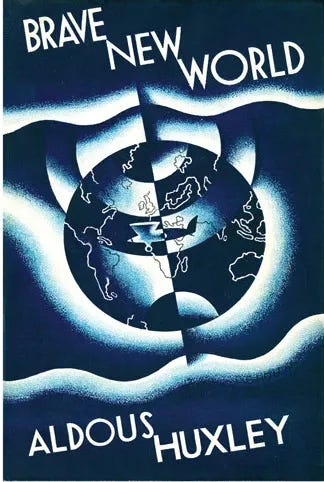
“Read 1984!” someone in your feed crows. “Read Brave New World! This is the horrible authoritarianism that we’re living through now.”
But crack open either of those books, reader, and you’ll be surprised — so will the person in your feed. Those stories aren’t solely about a hapless populace being crushed by a tyrant’s fist. Crucially, they’re about how members of that populace swallow beliefs about their agency. These beliefs ensure that they keep themselves and others fearful and trapped. The coercion is typically unwitting. It doesn’t feel like coercion, because it’s rooted in fear.
Let’s return to where we started: say you’re afraid, the people you know and love are afraid, and you feel the “good person” thing to do is remain stuck in that fear, absorb more of it so it turns into anger, and then become suspicious or critical of those who haven’t done the same. It would, you feel, be cold or decadent to do otherwise. This, you think, is what we do. If you’re not doing what we do, then you’re one of them.
But what if I told you that the real act of resistance is to the tyrant of fear in your own mind? What if the modern day equivalent of traveling to Madrid or the Alsace-Lorraine foothills is actually staying home, taking to the document (or the canvas, the piano, etc.), and collapsing the fear-based distinctions between us and them?
The thing that’s easy to miss about power is that it’s everywhere, even in places that might surprise you. Like your own mind.
You scroll, and it haunts you that other human beings could commit X or Y act. It’s scary to think of being on the receiving end of that act. It’s equally scary to think that it was committed by a fellow human. You feel you must ward against association with that individual and their ideologies; they are not to be understood and wrestled with, not to be seen as a mirror of something bigger, not to be learned from. No, they should be surveilled for, banished, and #resisted. Not only does your social group reflect this view — the news does, too. And so the uncertain times continue apace.
This is why I think it’s more important than ever to write novels, reader. Because the novel is an expansive form that allows for the exploration of big questions, moral gray areas, and multiple points of view. Because as long as we keep sharing slogans, exchanging our agency for a “good person’s” fear, and carving our species into unbridgeable ideological and identitarian camps, times will continue to be uncertain.
Go back and reread any of the thoughtful, ambitious novels you love. You’ll find there’s historical precedent for this, too.
Want to write past fear?
Writing Past Fear: The Novel Draft is for writers of all experience and skill levels, whether you’re just getting your feet wet or you’ve already written a book or two.
This class is for you if:
Your creative project feels stalled out or difficult due to anxieties ambient and internal
You want to build technical/craft-based skills as a writer
You have a set of themes or a question you’d like to explore in fiction
You want to develop sustainable creative rhythms to finish long-term projects
This class is designed to help you identify practical, actionable solutions to problems you’ve encountered drafting your novel and building a sustainable writing life more broadly.
Dates & times:
6 weeks (begins 2/1, meets until 3/8)
10:30-12:30 PT / 1:30-3:30 ET
Click here to register for Writing Past Fear: The Novel Draft
The class fee is $599 and includes a one-hour individual coaching session for each student. Class size is capped at 6 students. Zoom links and confirmation email will be sent upon registration.
If you have any questions about the class, are a current student, or need a scholarship or sliding-scale price, please write me here.
Saw G. Saunders on TV last night. He had similar things to say about what fiction can bring to our world --especially right now. I'm not surprised.