

(Wo)manosphere
On Freya India's Girls®, gendered delusions, and paranoid politics

If you’re new to the Cosmic Cheeto, hello and welcome! The below essay will be the first of two long reads this week. The second one, a response to Sam Kriss’s AI essay, will appear unpaywalled on Wednesday. Glad to have you here :)
There was a time when I met certain heterosexual standards of female attractiveness. Provided you were not a forum-dwelling dude who felt that a close resemblance to Emily Ratajkowski or Kendall Jenner was the bar every woman had to clear in order to be fit for inclusion in the category “woman,” you would have found me not unsuited to the task of attracting a man. This isn’t a polemic about compulsory heterosexuality, by the way – it’s a statement of fact that feels surreal to report all these years later. There are standards of female attractiveness (aka “traditional beauty”) dictated by male interests, and I met some crucial ones: I was thin; I had long brown hair; I had large eyes and collagen in my skin. I was not hot in a pillow-lipped, statuesque, sight-to-behold way; rather, I was “cute.” I got hit on occasionally in coffee shops and once, kind of confusingly, in a Bass Pro Shop.
I do not miss being this person. To conjure her image is to realize how thoroughly being her was not for me. Not because I’m not a woman, but because I felt like I’d been sorted into another woman’s life. Here I was in her tank tops and ballet flats, counting her calories, swiping on Tinder for the future father of her children. It all made perfect sense in the way death makes perfect sense as the ultimate extinction of consciousness…at least until you eat some hallucinogenic mushrooms.
To be fair, this very young woman and I seemed more alike than different at first. We both liked men well enough. We were both nauseatingly ambitious, which put some men off – though certainly not all of them – and we both seemed to enjoy sex. Her public persona only started coming unglued from my private self when the tasks assigned her began multiplying at an overwhelming rate.
There were the men who had enthusiastic suggestions, delivered while inspecting her body, about which med spa procedures could make her hotter. There was a kind of book she was expected to write (autofiction about her love life), a kind of dress she was expected to wear (always so small and uncomfortable), a kind of man people told her complemented her best (bearded; salt of the Earth; good with his hands). She and her friends were supposed to go as a group into high-end public bathrooms in order to fix their makeup and have “girl talk.”1 She could continue to pursue her arty “adventures” as long as she understood that a certain type of highly desirable, successful, creative man might have a low tolerance for this sort of behavior. Her attractiveness had an expiration date, and if she didn’t have a child by the time her face expired then she would be the pathetic overgrown baby.
And so on and so forth. I felt like Lucy and Ethel in the I Love Lucy episode “Job Switching,” working on an assembly line wrapping chocolates that start proliferating at an impossible rate. Warned by their supervisor that they’ll be fired if they let a single chocolate get by unwrapped, they start stacking them in piles, then eating them and scooping the rest into their work hats. “I think we’re fighting a losing game!” a harried Lucy calls to Ethel. Indeed they are: the deceived supervisor orders more chocolates to be sent in faster. There’s only so much chocolate those floppy hats can hold!
Eventually, one’s hat floppeth over. You must change trajectories. I was not simply at odds with the (im)polite chauvinisms that afflict women who desire men.2 I was at odds with desiring men itself. It wasn’t for me. I was interested in men in many of the same ways I was interested in women – as friends, as artists, as thinkers and conversation partners – but it was always the arrival of another woman into my life that introduced the opportunity for the kind of romance that tilts the Earth on its axis. I wanted to attract other women, to spend my life in their company. My “corporeal style” – Judith Butler’s term, not mine – began to shift, and this felt less like wrapping assembly line chocolates and more like observing the migratory patterns of a bird.
This happened for me in the post-#MeToo 2010s, an era in which, as Phoebe Maltz Bovy and I discussed in our recent Substack live, the definition of “woman” was rapidly narrowing. A worthy-of-desire female subject suddenly seemed to be the only female subject: the movie star hounded by a lecherous executive, the pop star abused by a manipulative record producer, the beautiful young girl groomed by a powerful and demented older man. Feminists were no longer wide-shouldered Bella Abzug types who needed men like fish needed bicycles. They were suddenly high-cheekboned Em Rata types, angry fish drowning in seas of bicycles.
There’s no doubt that a consciousness-raising movement like #MeToo needed to happen, nor that famous and conventionally attractive women are and have been the recipients of unwanted sexual advances and outright abuse. But the public fervor of the #MeToo era – the hunt for the Bad Man, his exposure and comeuppance, the cavalier Judge Judy drama of it all – eclipsed the realities of the countless normal women (and men) who’d also been victims of sexual assault. What of these individuals, too old or weird or under-resourced or gender-nonconforming to fit into the neat equation of Beautiful Woman and Bad Man? For those of us already feeling at odds with gendered lives we either didn’t want or couldn’t optimize our bodies for, sexual violence might function as a possible impetus for bodily abdication. Was I ever a woman suffering the humiliation of being letched at and groped by men if in fact I’d actually been a man all along?
As Maltz-Bovy maintains in The Last Straight Woman, this ever-narrowing definition of “woman” landed us athwart reality in some significant ways. For one, reality has shown us that someone who looks like Bella Abzug can still be sexually assaulted. It’s also shown us that the queer poly alloromantic demisexual she/they in your life is often just a heterosexual woman with a boyfriend she wanted to connect with emotionally before sex, and that the boyfriend probably enjoys threesomes. Words certainly matter, but not so much that they can instantly shape material reality, nor successfully interrogate one’s desires into nonexistence.
The undeniably straight and gender-conforming emerged from the 2010s in a funk of anxiety: heterosexuality was bad, dangerous, and retrograde; beauty was either just a little lip filler away or else rapidly fleeting. But the rest of us were in our own funk, too. Sure, the future may have been a queer anarcho-syndicalist fully automated utopia, but would we ever get there with all the climate destruction and late stage capitalism raging around us? What about the oppressors who were trying to kill us, or the gender dysphoria that might kill us first if we didn’t do something about it?
Like characters in a Sally Rooney novel bemoaning their inability to make pro-social life decisions and fix the great material problems of the planet, we were all swinging on mental pendulums between states of acute distress and the impulse to seek palliative relief. More often than not, that impulse began with picking up one’s phone.
And it was during the first few seconds of the relief-seeking scroll that our anxious minds were at their most porous and rockbottomed-out, their most availabe for algorithm-driven pitches, manipulations, and seductions. We sought external loci of control, and the internet was ready to provide them to us. There were apps for lovers and apps for drugs. Procedures to get us more lovers and telehealth companies to get us better drugs. There were sales opportunities and clout-building opportunities. Simple on-ramps to belief systems that showed us the face of the oppressor. Simple instructions for the oppressor’s neutralization.
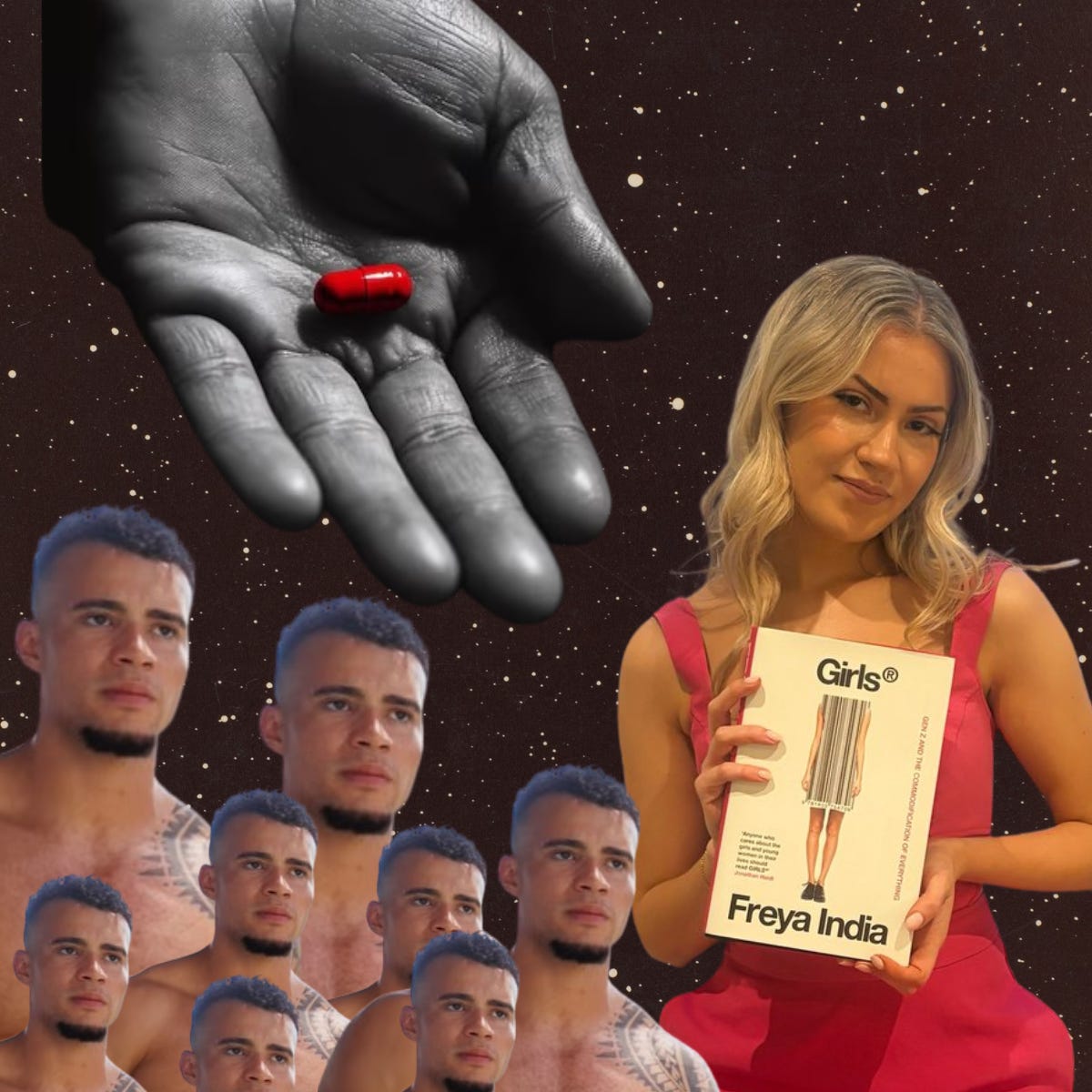
Anti-woke Gen Z commentator Freya India’s book Girls®, out this year in both the U.S. and U.K., is about these palliative internet choices and their long-term effects on her generation. Or at least it claims to be. Like so much cultural criticism positioning itself as a sane objection to the excesses of consumer-based identitarian progressivism, India’s book ignores the real genealogy of wokeness, preferring instead to argue her case along partisan lines more paranoiac than Girls® may want to admit.
If you’re going to sincerely ask “How did we get here?” as India does over and again in Girls®, then your answer cannot take the shape of conspiracy, cannot treat history as an ongoing battle between good and evil. You cannot, in other words, fight wokeness with more wokeness. Because when you engage in such a fight, you will not be a courageous champion of the truth. You will be a reactionary riding a hobbyhorse.
Keep reading with a 7-day free trial
Subscribe to The Cosmic Cheeto to keep reading this post and get 7 days of free access to the full post archives.