

My Codependent Internet
This one's for all the hand-wringing try-hards out there

Your support makes what I do here possible. Thank you <3
Creative satisfaction is happiness. Happiness is worth taking a gamble on yourself.
I’m deep in drafting my novel and less online for the next two months. Find me in person at my Essay Incubator class and at the first Cosmic Cheeto Zoom salon ;)
If you were to empty my head of all worries, fears, and expectations, you’d find me constantly triggered – not in the 2010s Twitter discourse sense, but in the poetic one.
When I am at ease, everything becomes a madeleine dipped in tea – or for all my Mary Oliver fans, a flock of wild geese – a mnemonic portal to a different time and place, a metaphor for something bigger than myself. If I were a poet, I’d write about how standing on a majestic bridge over a majestic creek in the hills of Northern California is like traveling through a spacetime wormhole to the year 1996, when I once spent an awestruck hour observing a group of dragonflies laying their eggs in a suburban drainage ditch.
I would not care if someone read my nature poem and wanted to pick a fight about it. I would not be concerned when someone unfollowed me because of it, nor when an old friend wrote me asking why I was being so reckless with my metaphors. I’d just write the words because I wanted to. They’d be an irrepressible consequence of my constant state of wonder.
But there’s no time left to have a head empty of all worries, fears, and expectations now, is there? Childhood has come and gone, and with it wonder – really, what good is wonder, anyway? Can it rehabilitate the economy? Can it improve the lot of the American underclass? Can it right the grievous historical wrongs that have landed us in the miserable climatological/geopolitical state of affairs we currently find ourselves in?
Pretend with me1 for a moment. You are thirteen and logging onto the internet on the family computer. The year is 2003. The scree SCREE screeee of your dial-up modem is loud and obnoxious but also immensely pleasurable, because whenever you hear it you know it’ll be just a matter of time until you can log onto AOL Instant Messenger and talk to your friends about a cool new band called Gorillaz. You will do this again and again in the years to come. You will watch two Russian brothers perform a perfectly coordinated dance to European techno. You will watch a man in a wig identify which shoes rule and which suck. You will see advice animal memes and a white-shirted creep named Tom will be your first friend on Myspace.
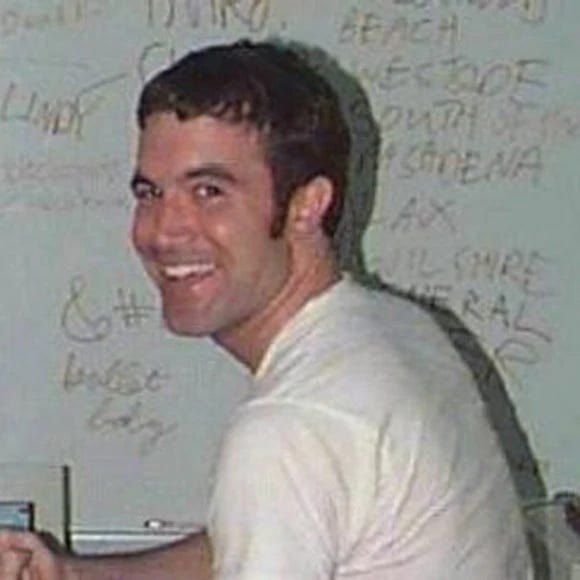
You’ve got a Myspace, which means you’ve got a Myspace photo. You’ve got to look good in it, which means achieving the right self-portrait angle with your dad’s digital camera. But you look chubby in every single photo. It’s humiliating, and it can’t be the fault of your stifling Aéropostale shirt, sewn by Rohingya refugee women in an airless factory on an entirely different continent. It’s got to be you: you need to lose weight.
Easy. You visit a website called Mind Over Matter for some thinspo. There, you learn to follow the #thinspo tag on Tumblr, where you find that one of your favorite enable-your-eating-disorder accounts is reblogging posts about matters of grave political importance. The president is a war criminal and his reckless indulgence of pea-brained American jingoism is going to get us all poisoned by anthrax! The economy got ruined by greedy Wall Street businessmen, and the globe is burning up!
You were just searching for starvation tips, but now you’re aware of the bleakness of the world in a way you weren’t before.
Your parents manage to block you from Mind Over Matter; thankfully, you lose interest in thinspo. You follow a different Tumblr account, this one for a fandom of your favorite fantasy series. It’s a big account, and the person running it is really smart. She’s trying to harness the power of the fandom to raise real awareness of issues you’ve only seen reblogged.
You need to learn about political correctness and social privilege and why representation matters in media, the fandom leader instructs you. She helps you see why these things are answers to global problems (the bad president, the melted planet, the shattered economy) and personal ones. Those personal problems have always been extra-humiliating. Why do you feel miserable at school and alone in your friend group? Why does it feel like lying to make yourself like the boy your family wants you to like, or pray to the God they believe in? Why did they think it made more sense to pop a VHS in the VCR instead of actually talking to you about the profound anxiety you’ve been experiencing ever since Derek from science class called you a fugly slut on AIM?
You were just searching for starvation tips, but now you’re aware of the bleakness of the world in a way you weren’t before.
On the fandom Tumblr page and elsewhere, answers abound. It’s as if a door has shut behind you at precisely the moment a new and shinier one has opened before you.
You were right about feeling like a fish out of water. You were right about the oppressive environment. You didn’t ask to be born weird in a Midwestern suburb that’s still, at the dawn of the new millennium, every bit the moral majority redoubt it was in 1963. You didn’t ask to be born into a species that seems psychotically unconcerned with the health and wellbeing of the very planet that’s sustained it. These realizations – clarifying though they are – wound you, and the wound scabs over with fear and urgency. You do what any young person does in such a situation: you rigidify your worldview.
This is right. This is wrong. There are good people, and there are evil ones. You know which side of history you’re on. You know all the “good side” tells and all the “bad side” ones. The internet is good at helping you sort these things out, isolated-together immaterial gathering place that it is.
Eventually, you graduate college and need a job (FML! LOL!) but you never stop needing a peer group. You are used to jumping through hoops, overthinking things, over-justifying your actions – there are plenty well-paying jobs that require all these skills, but the positions you want are all occupied by greedy older people desperate to keep their slice of the pie and gobble yours up, too.
As much as you hate the system and dream of a revolution, it’s actually your own fear that you hate. You would rather the system be restructured to accommodate you than see it abolished altogether. You want stability – who doesn’t? – but you also want prestige and power. Those baby boomers making you jump through insane professional hoops they themselves could never have cleared? They don’t just deserve to be de-throned: they deserve a comeuppance. That nuclear family that humiliated and excluded you? They deserve to be ruptured by the sheer correctness of your takes.
I say all this without judgment, by the way. Because if I were to judge anyone else for any of this, I’d be judging myself too.
Millennials, I now understand why Gen Z finds us simperingly earnest and “cringe.”2 They see us hand-wringing over the fates of systems we claim to hate, acting so surprised when all those gifted classes added up to five figures of student loan debt and a job coding for Amazon.
No wonder they’ve invented a neologism – “cheugy” – to describe the way we’ve managed to aestheticize trying too hard. Cheugy is “adulting” and “I did a thing” and Buzzfeed listicles and optimistic folk rock and telling privileged people to 👏 sit 👏 down👏 and 👏 listen 👏 up 👏 and feeling so lucky that you get to marry your best friend! Cheugy is investigating the origins of the word “cheugy” for the New York Times.
Cheugy is an aesthetic of insincerity. A millennial cheug’s Twitter bio might exhort us to Smash the patriarchy! Smash the binary! Eat the rich! But if everything got smashed, there’d be rubble. And I’m not convinced millennials are ready to play in that rubble. More likely, we’d divide ourselves up into Hogwarts Houses and try to find the worthless chud among us whose wanton AI use caused the collapse of society.3
And to be clear: it’s not like we’re incapable of producing rubble. Our world keeps changing – we cannot help but change it by increments, social, phototropic beings that we are. But these community and light-seeking strengths are also weaknesses. We care so much about what others think that we identify social approval with material safety. We see the past as a problem to be solved as opposed to the roadmap that’s led us to the present. We see the future as predetermined, and therefore impossible. We see happiness as externally mediated, and therefore impossible. We see inherent value as a concept that can be gestured at via a Rest Is Resistance meme instead of what it actually is: the thing you will stumble upon when you stop stewing in the shit that’s happened to you and notice what you’ve made happen.
On the internet, answers abound. It’s as if a door has shut behind you at precisely the moment a new and shinier one has opened before you.
The trauma plot is cheugy. It’s an appeal to emotional stasis as moral righteousness. It’s a way to dissimulate. Elliot Page and Lena Dunham are brilliant millennial artists whose work has consistently made me feel, provided recognition catharsis, positively shaped my self-concept. And yet both of them have released ham-handed trauma plots in the past five years: for all the emotional muscle he put into his performance, Elliot’s Close to You is like a film adaptation of an Instagram reel about trans immiseration cobbled together by an ACLU intern; Lena’s Too Much is about how everything difficult in her heroine’s life can be traced back to the comically vile influence of a comically vile boyfriend.4
The trauma plot describes a Manichean world of oppressed vs. oppressor. Good vs. bad. Light vs. dark. Writing your own trauma plot, you’re convinced you’re battling the forces of evil. But what you’re doing is evoking the rigid worldview forged by the teenager you once were in the chatrooms of your youth. You are consumed by the actions and attitudes of others, not the sovereignty of your mind and its emotions.
To paraphrase a Buzzfeed quiz: If this sounds like you, then you’re SO not ready to play in the rubble!
As I was born in 1989, I can’t think of a less cheugy way to put this: the state of wonder is the revolution you’ve been daydreaming about. It’s not something you lost in childhood; it’s not something that’s been stolen by American capitalism5. Things can certainly befall you that make it feel remote and impractical – difficult and painful things, even tragic ones. And the world can remain crawling with people you disagree with – in fact, I promise it will.
But until you do the first unmeasurable, unvalidated thing you want to do – write the book, paint the mural, leave the grad program, leave the marriage, quit the job without another lined up – you will be trapped in a matrix of expectations and fear. Until you treat your own worthiness as an article of faith, you will feel existentially beholden to institutions, perpetually thwarted and unconvinced of your future. You will remain unconvinced of your power.
I’ve been revisiting the career of Bo Burnham lately. We are almost exactly the same age, and I loathed him when he rose to viral fame on the internet in 2006. He was another obnoxious teen boy like the ones who bullied me at school, and now he was gobbling up all that precious precious institutional validation. For the next fifteen years, he was another mediocre white man to me, another problematic fave of any person clueless enough to recommend one of his specials, an offensive dirtbag.
And then in 2021 I watched his film Eighth Grade at the recommendation of a grad student. I realized I’d been grievously wrong about him.
That Bo Burnham is brilliant has been obvious to millions; after 15 years, I am finally among them. But I’m not just sharing the above video with you because it’s possibly the most hilarious Kanye impersonation I’ve ever seen – I want you to pay special attention to what Bo says beginning at the five-minute mark.
Here are some select quotes:
The truth is my biggest problem is you / I want to please you / But I want to stay true to myself / I want to give you the night out you deserve / But I want to say what I think / And not care what you think about it…
A part of me hates you / A part of me loves you / A part of me needs you / A part of me fears you…
Come and watch the skinny kid with the steadily declining mental health / And laugh as he attempts to give you what he cannot give himself…
These are the words of someone who grew up on the internet. Someone who’s memorized all the social best practices and is terrified of screwing up. Someone who, I assure you, is so busy wrestling with the shit that either has or might happen to him that he cannot see the incredible things he’s already made happen.
“I hope you’re happy,” Bo says at the end of the Kanye rant, in a tone that suggests he earnestly hopes he’s made the audience happy. Writing this now, I find myself hoping they’re happy, too.
I hope every last person in that theater has experienced some form of peace in the ten years since that special was filmed. And I hope Bo is happy; I believe he can be. Same goes for the executives who put him on that stage, and the younger comedians waiting in the wings, and all the people they’ve loved and hurt, and all the millions of people who watched the Netflix special and thought, He is so much better than me. I could never do that.
And you, reader. I sincerely hope you’re happy, too.
Related reading:


In other news:
I’m in the throes of novel drafting, so will be less interactive on this website for the next couple months. I’m also going to Australia next month! (Byron Bay readers, come to the Writers Fest!)
I will still aim to bring you: 1 long read per month + regular author interviews + shorter unpaywalled cultural criticism as it occurs to me. And if you want to chat this summer, find me here:
1. Essay Incubator class
Essays that sell your book, and establish your online presence as a writer. Sign up here. (Founders get 50% off!)
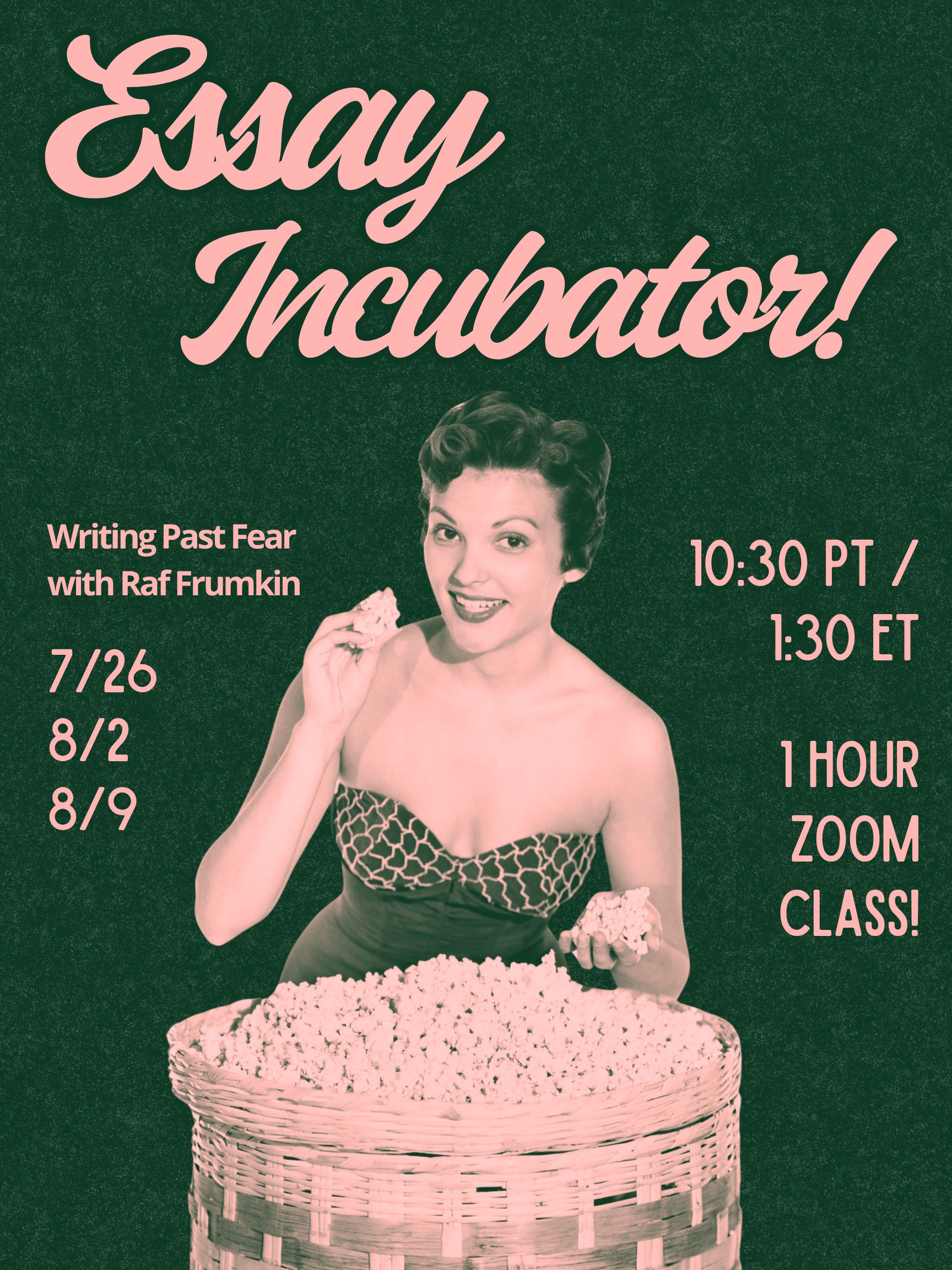
2. Zoom salon
For Cosmic Cheetoans who want to get together live and chat on a theme! August’s theme: Writing Past Fears of Failure, Cancellation, and Self-Judgment. Sign up below:
3. Office Hours
Sign up and shoot the breeze! (Founders get 2 free Office Hours sessions per year.)
Or reminisce with me, depending on your age.
And lest you accuse me of pandering, know that I intend to change nothing about this here sincerity blog that actual Zoomers have described to me as “eyeroll-worthy,” especially this note.
Fun fact: Ravenclaws invented the robotaxi.
I wish this was just autofiction and the boyfriend had been social media and Lena had played the troubled lead, recasting Meg Stalter as a hilarious and irrepressible little sister.
Nor by Soviet totalitarianism, nor by the president of the DRC, etc.
not cute, tom. but also tom, cute