

You Are *So* Valid!
The personal is sometimes hypocritical

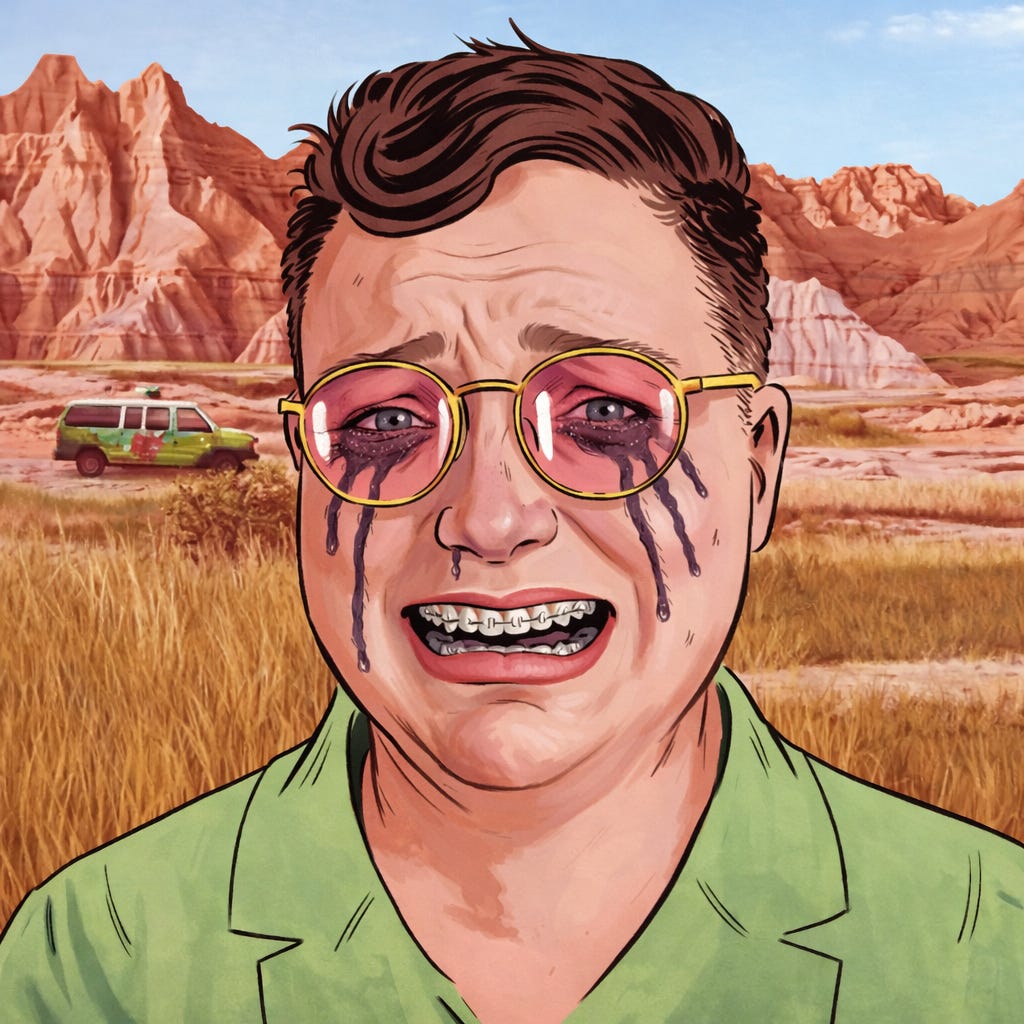
In a social experiment that quickly turned antisocial, I decided to sift through reader comments about a story I’d recently published. It was a story about womanhood being a series of self-objectifications in service of other people’s standards, and someone I’ll call Queers2Tears had commented something like: Rafael Frumkin wrote this? I thought he was a trans guy?
I’d seen this sort of question posed two or three times before, often with gender-neutral pronouns and an air of expectant fear, as if the mere act of incorrectly invoking my gender could somehow kill me from afar, activate me to leap from a bridge like a self-destructive sleeper cell and earn the reader a charge of involuntary manslaughter. But I hadn’t seen what came next.
Queers2Tears found my second book’s depiction of gay men satisfactory, but not its depiction of women. I was, they insinuated, a misogynist, and anyone who paid attention to how I depicted women could see as much. Then followed the quotes from my book in which women were described as “vacant-eyed” or vengeful or overly bubbly. I would not read Frumkin again, they concluded.
The portrait was not flattering. I felt embarrassed, angry, and naked all at once. It was the same way I’d felt in the early days of the pandemic, when a trans friend took a photo of me from an unflattering angle. I told him it was an awful photo, that my body always looked humiliating in photos, and that he should delete it immediately.
He shrugged and complied, but not before reminding me that transition was the only real cure for dysphoria.
*
I am not, strictly speaking, a gold-star lesbian. Besides the matter of my numerous past boyfriends, I lack certain signposts of butchness, or what Judith Butler might have referred to as a “masculine corporeal style” during a more coherent career phase.
I am not someone who swaggers with confidence. I do not drive a truck with one hand, nor do I laugh sharply and in a way that fills an entire room. I do not have a well-defined jawline. If you were to meet me in person, you would not describe me as “emotionally distant” or “stoic.” You’d be far more likely to describe me as eccentric. Hyper-observant. Soft to the point of doughiness. If you were mad at me, you might find a way to describe me as crazy, obsessive, or self-involved.1 But I can assure you that on no occasion would you glance over at me, trace my gaze into the middle distance, and think: I wonder where she’s gone in her mind? You wouldn’t have to wonder, because I’d tell you within seconds. I’d even monitor your expression for signs of approval.
So what did it mean that I always felt a whisper of butchness in me? Long before my corporeal style evolved beyond “girl in dress,” when I still told everyone I’d grow up one day to marry a man and start a family. And to be clear, I’m not talking about something like loving trucks more than dolls (I loved them both). It had more to do with loneliness, weirdness. Outlierness. Girding myself for disappointment.
My mom left her job to stay home with me. Not a decision she remotely regretted, she told me. And she’d fully support whatever decision I chose to make in the future, including not doing the same as she had. In the 90s, she and other boomer women were awakening into the grips of full-time motherhood like the characters in Meg Wolitzer’s 2008 novel The Ten-Year Nap. They were staring down the fruits of second-wave feminism and asking, “Wait – is this it?”
As a teenager first dipping my toes into feminism2, I learned that thwarted ambition was a scary thing. I learned that a woman should never compromise her dreams for a man, that she should be established in her life and career before consigning herself to the obligations of marriage and family.
These lessons were all well-intended, and in many frameworks quite true. But as I read, I was also learning something else. Something subtextual. These lessons weren’t intended for me. I wouldn’t need to negotiate my life around my womanly sense of devotion because love wasn’t coming for me.
And this wasn’t because I looked unfeminine. Sure, I was scrambling not to be thrown from the relentless treadmill of Appropriately Sexy Femininity along with every other woman and girl. I wanted to be thinner and have fuller hair and a prettier neck. But I still cleaned up well enough. I could wear a baby doll dress and have a praiseworthy BMI and delicate wrists. That I appeared, cosmetically, to perform “woman” well was not the problem. The problem was what happened whenever I opened my mouth.
I didn’t learn this one way, from one person. I learned it many ways, from many people. It caused me to foreclose on love, which was an idea that had never particularly appealed to me anyway. Being completely materially and emotionally dependent on a romantic relationship with a man? Sounds awful! Hadn’t the whole point of feminism been to avoid that?
I still dated men. I slept with them and swiped right on them. Sometimes, I found one who I imagined might be able to defy the odds, like the nerdy lumberjack I met in my early twenties. I was supporting us both financially (he’d turned down a “well-paying job offer” in Milwaukee to stay with me in Iowa, you see), and I thought I could wear a lot of bodycon and really make it work.
I felt this way up to and including the moment he tearfully gave me a three-page, single-spaced document outlining all the lies he’d told me. After that, he had to “take some time to clear his head.” He sent his brother to collect his bongo drums from my apartment before returning himself the next morning to dump me.
I grieved the fact that someone I loved had been shitty to me, and that aspects of my future now looked much different than they had before, and that maybe his shittiness hinted at my brokenness in a way I should pay better attention to. But I didn’t feel as if some great source of meaning had left my life. And perhaps that’s partly why he’d grown to dislike me: his was not the approval I sought. I had sex, I had situationships, but I had no dream man.
You might think I’m trying to position my young self as some coolly detached, divinely enlightened eighth-wave goddess. But I wasn’t coolly detached. I was quite attached. Severely, chaotically attached. Of course I wanted men’s approval. I hungered for it. But I didn’t want them to propose to me. I wanted them to tell me I was as brilliant and special as I thought they were.
As much as I loved feminist theory, I also really loved books by men. Books about the senselessness of war and the existential nightmare of suburban living and figuring oneself out as an artist. I loved the way men talked about their books with bravado, the way they praised other men’s books, the way they felt serious consideration was owed them and then said as much and then got it. I loved the abstruse vocabulary and paranoid plots and sentence-level maximalism.
I wanted men to give me prizes, to canonize me3, to debate me, to concede debates to me and say half-jokingly, “The better man won.” I wanted to have a big sprawling career like they always got to. I didn’t want to be one of the gamine young women who flitted in and out of their novels. I wanted to write those novels, and do it so well that they’d have to concede the existence of another kind of woman altogether.
The more I wanted this approval from men, the less they seemed willing to give it. The deeper they burrowed into their Pynchon novels, neglected their emails. But I wrote them anyway:
No, Sontag and Murdoch and Arendt weren’t outliers. There are so many of us, and we’d rather talk about philosophy instead of having sex with you and making dinner for you. We’d like to stand in rooms smoking clove cigarettes and debating the meaning of life. We’d like to be colleagues, not lovers – not even lover-colleagues.
It’s the kind of thing you should be able to say with impunity, but for some reason don’t want to. The kind of thing that really shouldn’t rub guys the wrong way – not post-#MeToo and post-white feminism, not since the shitty media men have all been rounded up and gender reimagined as a spectrum for pre-literate children and the scammer girlbosses exultantly dethroned!
But somehow it still does.
*
I didn’t have my first serious lesbian relationship until my mid-twenties. As usual, I was the femme. I performed Appropriately Sexy Femininity, albeit this time with more flannel. My girlfriend was the butch breadwinner, collected sneakers and vaped and did something with UX design4. We planned to get married sometime in the future, after which I would do IVF and carry our child. In the meantime, I would be at home. Not cooking – I couldn’t cook, really – but possibly…cleaning? Writing little stories while looking cute? Staring out the window wistfully?
I moved into my girlfriend’s condo but I did not stop working. I published my first novel, and then got a one-year visiting gig at a university in Louisiana. I imagined we’d do long distance – we had such a solid five-year plan, after all! But I wasn’t surprised when she dumped me from afar and announced her engagement to another woman two weeks later. I was disappointed, certainly, but then I’d been taught to be disappointed. I was talkative and ambitious. Like any good gay girl in the 2010s, I took plenty of selfies and psych meds and worked on atoning for my privilege. But I also did this weird thing where I read and enjoyed books by Philip Roth and James Joyce.
I love white men, I told myself. And that’s why people don’t love me.
And then, a small insistent spoke up in response: People don’t love you because you are a white man.
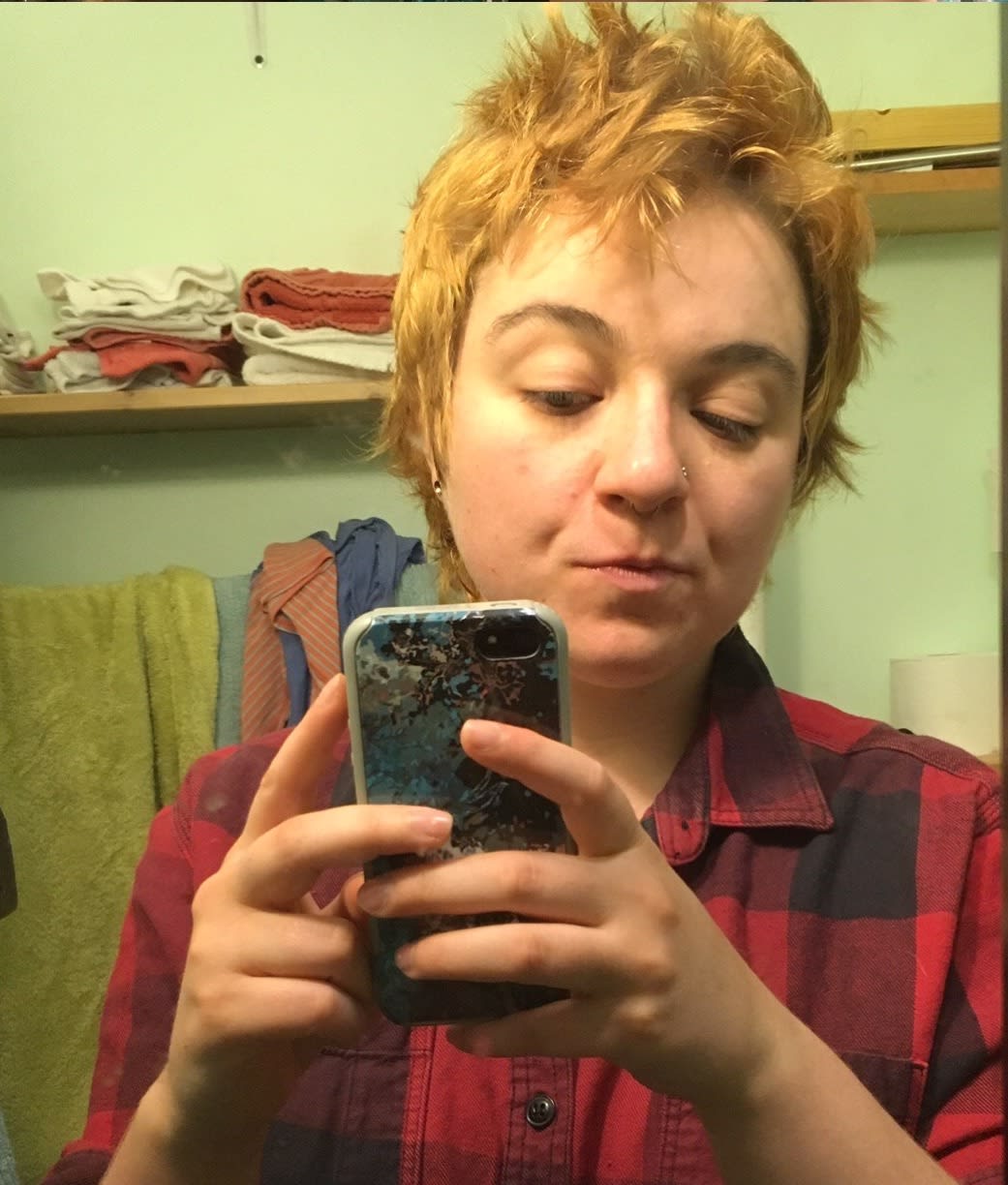
I changed my pronouns and drifted towards a different corporeal style. Short hair and gray jeans and tinted glasses. The testosterone and surgery were only a couple years off.
For an embarrassing period, I decided to be “studly.” In theory, this meant seeing as many women as I could at once. In practice, it meant that I went on dates with three people in as many weeks and then quietly melted down with anxiety on a sweltering New Orleans afternoon deciding how to text each of them back. Not exactly Nathan Zuckerman; not even a soft boi version.
But consider me in the lit world, and you’d have a different story altogether. There, it didn’t matter how numb I pretended to be: the numbness wasn’t there. I was the girl wasting whole days painting her nails by the phone, waiting for my destiny to call.
I was not in love with my grad school mentor, but I wanted to please him at all costs; his silence after my first novel flopped felt like the worst kind of referendum on my self-worth. When a Hollywood acquaintance called me “annoying” before complaining about his fear of getting #MeToo-ed, I was ashamed: I had been texting him pretty dramatically about a recent manuscript rejection. Why did I have so many feelings all the damn time? Why couldn’t I just be cool? And most importantly — why did whatever validation I was getting feel so insubstantial, so temporary? Why was I failing so hard at the love I wanted?
I strove, and bitterly. I tried to be attention-worthy, to please people in ways that would make them take my career seriously, to argue for my piece of the pie. No, no, nononono, I was not another cis white girl with basic opinions. I had an interesting mind and a worthy heart and I just needed confirmation of that from some natty Brown grads and the NEA.
I got drunk and loud at parties. I cried in public. I compared myself relentlessly. I sent impulsive emails. I apologized too much. I was clingy. I settled for crumbs. I berated myself for acting like “such a girl.” And all because I wanted to write a Big Important Novel – the kind written by one of the boys.
God, how I’d begun to hate those boys. I filled my face with piercings, dyed my hair pink, and seethed. The makeover was physically painful, which felt cleansing.
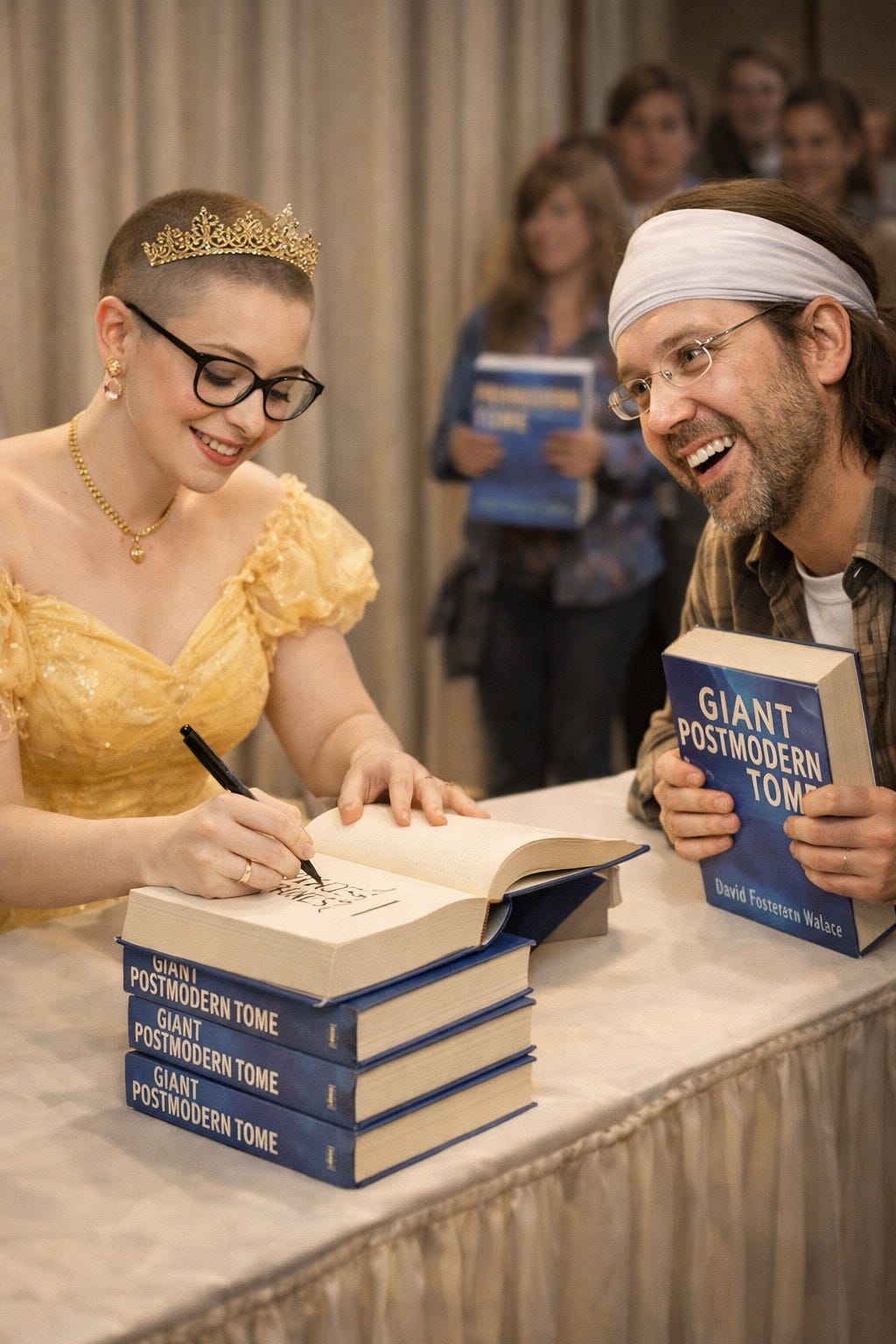
I did have a dream man after all: David Foster Wallace, undead. We wouldn’t get married, of course. Instead, he’d sign his MacArthur Genius Grant over to me in front of a massive audience. New Yorker totes stowed beneath their seats, they’d clap with feeling and think: In this moment, we perceive this woman as stronger and smarter than this dwindling imp of a man. And I would give a long learned prolix speech while David Foster Wallace listened attentively, taking notes. And then I’d sign David Foster Wallace’s copy of my book (Thanks for the laughs, Dave! xoRaf) and shake his hand so hard I’d crush it a little. And that would be my happily ever after.
Did I want love? Yes, of course. From the whole world outside of me. This is a system with no evil beneficiaries nor perfect victims because it presupposes two “rules” that benefit exactly no one:
1) Love must always be earned from other people, regardless of the medium (your body, your words).
2) There will never be enough love to go around.
This means that even if you’re at the top of the pyramid, endlessly affirmed (or else just very good at coercing people into affirmation), you’ll still have this nagging feeling of emptiness, this notion that you’re being drained. You’ll need to stoke those external flames of ardor again and again because that’s the only place love is – the only place worth is – and when those flames eventually go out, so do you.
*
My whisper of butchness actually saved me. And I don’t mean that it “saved” me from the so-called prison of heterosexuality.5
I was saved by the eradication of pressure, any sense of expectation that my life’s meaning or material security could be found in a romantic relationship. I had really just expected to have some liaisons and die an elderly spinster; I was stunned when I fell head over heels for the woman I’m currently married to. Perhaps it sounds like a cliché – just when you stop looking, etc. – but it’s true. Reader, I was never looking to begin with.
But my torrid affair with the attention economy was a different story. There, things felt intractably heavy. There, I was still a girl, appraised and forever lacking.
What did it take, to finally stop plucking the petals off daisies and wondering whether I’d ever be loved back? Was it realizing, while watching yet another male colleague fall to pieces during a faculty meeting, that “acting clingy” is actually just how anyone acts when they’ve allowed themselves no sense of self-worth beyond what some heavily gatekept, scarcity-manufacturing marketplace of prestige grants them? Was it hanging up my own New Yorker tote (spiritually speaking) and writing neither to please, nor to be one of the boys, but just to be who I am? Was it finally arriving at the point that I no longer felt the need to exfoliate my psyche with barbs from dissatisfied commenters, to reassure readers who misperceive me that there’s actually a correct interpretation, that I am actually quite safe and palatable and good?
If I responded to Queers2Fears now, it would read something like this:
Yes, for a while I was a trans guy hell-bent on the suppression of myself. I probably felt distant from or even envious of the women in my book when I wrote those sentences about them. I have more in common with them than I do with the two male leads.
It’s funny you say that about how I write women, because I’ve felt precisely what you’re feeling. I used to read books by men and boil over with resentment at the insulting depictions of women. I’d vow to never read those men again. And for a long time I wouldn’t.
But I’ve come back to many of them – not because I think they’re blameless or even all that relevant, but because I think there’s something to be learned from any writer. Even the ones writing from frameworks of belief that limit the imagination and strain empathy; even the ones that embarrass me. They can still move me. It’s because they are still human, and humans are interesting.
For what it’s worth, I don’t think books can tell us exactly how to live. But I do think they can nudge us in the direction of our best living. Hope this doesn’t sound presumptuous — I’m speaking as someone who’s gotten pretty comfortable with making mistakes.
Hello and welcome, new subscribers! I’m writing a novel about all the above6 and more!7 A deep cut from an early draft here:
My other books here and here. And my feelings on hotness here:
Cue Hannah Horvath: “Any mean thing someone’s gonna think of to say about me, I’ve already said to me, about me, probably within the last half hour.”
This was mostly second-wave fare: “millennial feminism” (aka the third wave meets the blogosphere) was still a decade or so away.
Imagine feeling this way in the 2010s, as white men were falling out of favor in publishing (and everywhere else). Somehow I did not read the tea leaves and feel ascendant, did not want to write a 215-page speculative novel about being a weird gay girl. I was like a person watching the Johnny Carson show on an iPhone.
I forget what.
There is nothing pathological about heterosexuality: Taylor Swift could just as easily have written Life of a Showgirl, an album-length argument for the supposed joys of codependency, about her marriage to a woman.
Transition, detransition, seeking male approval.
Small-town cults, sociopaths, going to absurd lengths for creative success, friendships that end in grifts (and vice versa).
Beautiful piece. So relatable. Keep rocking it, Rafael.
Beautiful. I love how you share your rawness inside. Thank you Rafael.